
Education
Cocoon or Cacoon? Which Spelling Is Correct? (Complete Grammar Guide)

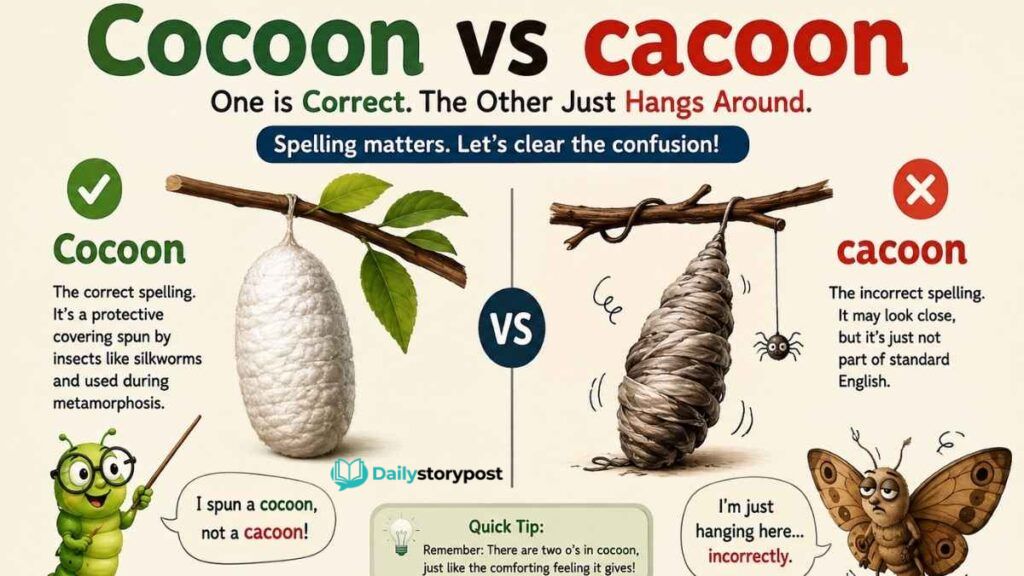
Have you ever typed “cacoonâ€Â and wondered whether it was the correct spelling? You’re not alone. Many English learners, writers, students, and even native speakers occasionally confuse cacoon and cocoon because the words sound somewhat similar when spoken quickly.
The good news is that the answer is straightforward: “cocoon†is the correct English word, while “cacoon†is generally considered a misspelling.
However, understanding why this confusion happens and how to avoid it can help improve your writing accuracy and confidence.
In this guide, you’ll learn the difference between cacoon or cocoon, discover the correct meaning and usage of cocoon, explore real-world examples, review common spelling mistakes, and learn practical strategies for remembering the correct spelling.
What Is the Correct Spelling: Cacoon or Cocoon?
Cacoon or Cocoon
The correct spelling is cocoon.
Quick Answer
| WordCorrect?Meaning | ||
|---|---|---|
| Cocoon | ✅ Yes | Protective casing formed by insects during development |
| Cacoon | âŒÂ No | Common misspelling of “cocoon†|
If you’re writing in English, you should always use cocoon unless you’re referring to a specific brand, product name, or proper noun intentionally spelled differently.
What Does Cocoon Mean?
A cocoon is a protective covering spun by insects such as moths and some butterflies during their transformation into adults.
Example:
The caterpillar built a cocoon before becoming a moth.
The word can also be used figuratively to describe a safe, comfortable, or protected environment.
Example:
She spent the winter in a cocoon of warmth and comfort.
Why Do People Write “Cacoon�
People often spell it as cacoon because:
- The pronunciation can be misleading.
- English spelling patterns are sometimes inconsistent.
- Typing errors occur frequently.
- Learners may assume the first vowel is “a†instead of “o.â€
Read More:Â Suing or Sueing: Which Spelling Is Correct?
Understanding the Meaning of Cocoon
The word cocoon has both literal and figurative meanings.
Literal Meaning
In biology, a cocoon is a silk casing created by certain insect larvae.
Example:
The scientist observed a cocoon hanging from the branch.
Figurative Meaning
In everyday language, cocoon often represents protection, comfort, or isolation.
Examples:
The cabin became a cocoon during the snowstorm.
Parents often create a cocoon of safety for young children.
Business and Lifestyle Usage

Many writers and marketers use cocoon metaphorically.
Examples:
- Cocoon of luxury
- Cocoon of comfort
- Cocoon-like workspace
- Cocooning lifestyle
Cacoon or Cocoon
Cacoon or Cocoon
Why the Spelling Confusion Happens
English contains many words whose pronunciation doesn’t perfectly match their spelling.
Similar Sound Patterns
Words like these often create confusion:
| Correct WordCommon Misspelling | |
|---|---|
| Balloon | Baloon |
| Occasion | Ocassion |
| Cocoon | Cacoon |
| Committee | Comitee |
Because the first syllable in cocoon is unstressed, some people hear it differently and accidentally replace the “o†with an “a.â€
Influence of Regional Accents
Different accents can slightly change vowel sounds. As a result, listeners may incorrectly assume the spelling is cacoon.
Auto-Correct Doesn’t Always Help
While most modern spell-checkers recognize cocoon, typing quickly can still result in errors that go unnoticed.
Cacoon vs Cocoon
Cacoon vs Cocoon
Cacoon vs Cocoon: Side-by-Side Comparison
| FeatureCocoonCacoon | ||
|---|---|---|
| Valid English Word | Yes | No |
| Found in Dictionaries | Yes | No |
| Accepted in Academic Writing | Yes | No |
| Commonly Used | Yes | No |
| Recommended Usage | Always | Never |
Dictionary Recognition
Major dictionaries recognize cocoon as the standard spelling.
You can verify this through trusted sources such as:
- Merriam-Webster Dictionary
- Oxford Learner’s Dictionaries
None of these dictionaries list cacoon as a standard English word.
Writing Recommendation
Whenever you need the term, use:
✅ Cocoon
Never:
âŒÂ Cacoon
Read More:Â Commit vs Comit: Correct Spelling And Usage Guide
Real-Life Example: How a Small Spelling Error Can Affect Professional Writing
Imagine a university student preparing a biology research report about insect metamorphosis.
The student writes:
“The moth develops inside a cacoon before emerging.â€
Although readers may understand the intended meaning, the misspelling immediately reduces the document’s credibility. Professors, editors, and academic reviewers often view spelling accuracy as a reflection of attention to detail.
Now consider an online business selling educational science materials. If product descriptions repeatedly use cacoon instead of cocoon, several problems can occur:
- Readers may question the site’s professionalism.
- Search engines may struggle to associate the content with the correct keyword.
- Educational value decreases because learners see incorrect spelling.
- Brand trust can suffer over time.
The company eventually updates all content to use cocoon consistently. Within months, user engagement improves because visitors perceive the content as more reliable and authoritative.
This example highlights an important lesson: even a single-letter spelling mistake can influence credibility, user trust, and overall communication effectiveness. Whether you’re writing academic papers, blog posts, marketing content, or social media updates, using the correct spelling matters.
Language and Search Trends: Why Correct Spelling Matters in 2025–2026
According to ongoing search behavior studies from organizations such as Google Search Central and industry research published by HubSpot, search engines have become increasingly effective at understanding user intent and correcting common spelling mistakes.
Key Trends
- Search engines automatically suggest corrected spellings.
- Users are more likely to trust grammatically correct content.
- Accurate spelling improves readability and professionalism.
- Educational and informational websites benefit from language precision.
What This Means for Writers
If your article, report, or website consistently uses the correct spelling cocoon, it appears more authoritative and trustworthy.
This is especially important for:
- Bloggers
- Students
- Teachers
- Content creators
- Business owners
- SEO professionals
How to Remember the Correct Spelling of Cocoon
Spelling mistakes happen, but a few simple memory tricks can help.
Trick 1: Think of Two O’s for Protection
The word cocoon contains two pairs of the letter “o.â€
co + coon
Imagine the two “o†pairs forming a protective shell around the insect.
Trick 2: Associate It with Common Words
Notice similar patterns:
- Cool
- Moon
- Balloon
- Cocoon
These words use the “oo†sound.
Trick 3: Visual Memory
Picture a caterpillar wrapped inside a round protective cocoon.
The rounded shape can remind you of the rounded letter o.
Common Examples of Cocoon in Sentences
Biological Usage
The caterpillar remained inside the cocoon for several weeks.
Scientists examined the cocoon under a microscope.
Everyday Usage
The blanket created a cozy cocoon around her.
The hotel room felt like a cocoon of comfort.
Professional Writing
The brand promises customers a cocoon-like experience of relaxation.
The architecture was designed to create a cocoon of privacy.
Cacoon And Cocoon
Cacoon And Cocoon
Common Mistakes to Avoid
Mistake 1: Writing Cacoon
Incorrect:
The butterfly emerged from its cacoon.
Correct:
The butterfly emerged from its cocoon.
Mistake 2: Using Spellings Based on Pronunciation
English spelling often differs from pronunciation.
Always verify unfamiliar words using a dictionary.
Mistake 3: Ignoring Spell Check Suggestions
Modern writing tools usually identify cacoon as an error.
Take a moment to review suggested corrections.
Read More:Â Submission vs Submittion: Learn The Correct Spelling
Mini Quiz: Cocoon or Cacoon
Quiz 1: Which spelling is correct?
Question: Cocoon or Cacoon — which is correct?
Answer:Â Cocoon
Quiz 2: Fill in the blank
Question:Â The correct spelling is .
Answer:Â cocoon
Quiz 3: What is wrong spelling?
Question:Â Which word is incorrect?
Answer:Â Cacoon
Quiz 4: Fill in the blank
Question:Â A cocoon is made by a (insect stage).
Answer:Â caterpillar
Quiz 5: Meaning check
Question:Â What does cocoon mainly mean?
Answer:Â A protective covering for insects
Quiz 6: Fill in the blank
Question:Â The butterfly comes out of a .
Answer:Â cocoon
Quiz 7: True or False
Question: “Cacoon†is a correct English word.
Answer:Â False
Quiz 8: Fill in the blank
Question:Â Cocoon can also mean a place of and comfort.
Answer:Â safety
Quiz 9: Choose the correct option
Question:Â Which is used in English writing?
A) Cacoon
B) Cocoon
Answer:Â B) Cocoon
Quiz 10: Fill in the blank
Question:Â A cocoon is part of insect process.
Answer:Â transformation
Quiz 11: Spelling test
Question:Â Which spelling is correct?
Answer:Â Cocoon
Quiz 12: Fill in the blank
Question:Â Many people mistakenly write instead of cocoon.
Answer:Â cacoon
Quiz 13: Quick understanding
Question:Â Cocoon is mainly related to which field?
Answer:Â Biology
Frequently Asked Questions
Q1: Is cacoon a real word?
A: No. Cacoon is generally considered a misspelling of cocoon and is not recognized as a standard English word.
Q2: Which spelling is correct: cacoon or cocoon?
A: Cocoon is the correct spelling.
Q3: What does cocoon mean?
A:Â A cocoon is a protective casing created by certain insect larvae. It can also refer metaphorically to a safe or comfortable environment.
Q4: Why do people spell cocoon as cacoon?
A:Â The mistake usually occurs because of pronunciation confusion, typing errors, or unfamiliarity with the word.
Q5: Is cocoon used outside biology?
A:Â Yes. It is frequently used figuratively to describe comfort, safety, privacy, or protection.
Q6: Can using “cacoon†hurt SEO?
A:Â Potentially. While search engines often understand misspellings, using the correct spelling improves professionalism, clarity, and keyword relevance.
Q7: How can I remember the correct spelling?
A: Remember that cocoon contains two “o†pairs, creating a visual image of a protective shell.
Conclusion
If you’ve been wondering whether cacoon or cocoon is correct, the answer is simple: cocoon is the proper spelling, while cacoon is a misspelling.
Understanding the difference helps you communicate more clearly, write more professionally, and avoid common language mistakes. Whether you’re discussing insect metamorphosis, describing a cozy environment, or creating online content, using cocoon correctly strengthens your credibility and improves readability.
The next time you see cacoon, remember that the correct word is cocoon with two pairs of “o†letters forming the protective shell that the word represents.
By practicing accurate spelling and verifying unfamiliar terms, you’ll become a stronger and more confident writer.
In recent years, the word pulsamento has started appearing in online discussions, creative communities, and educational content. While it may not yet be a mainstream term in dictionaries or academic literature, it carries a fascinating idea: rhythm, movement, and the repeating patterns that shape our world.
At its heart, pulsamento is associated with the concept of something that pulses, beats, or moves in a steady and meaningful way. Whether we are talking about the human heartbeat, the rhythm of music, the flow of communication systems, or even the patterns found in nature, pulsamento offers a simple way to think about how repetition creates structure and harmony.
This guide is designed for readers who have come across the term and want a practical understanding of what it means. Rather than relying on complicated language, we will explore pulsamento in a straightforward and human-centered way.
The term pulsamento is believed to derive from the Latin word pulsare, meaning “to strike,” “to beat,” or “to pulse.” Similar roots can be found in words such as pulsation, pulse, and pulsating. Across several languages, these terms describe rhythmic movement or recurring action.
BIO
| Label | Information |
|---|---|
| Name | Pulsamento |
| Type | Rhythm and pulse concept |
| Meaning | Repeating movement or pattern |
| Origin | Derived from Latin “pulsare” |
| Main Idea | Rhythm, continuity, and motion |
| Common Uses | Music, biology, and technology |
| Related Terms | Pulse, pulsation, oscillation |
| Key Feature | Consistent repetition over time |
| Practical Example | Human heartbeat |
| Learning Difficulty | Easy for beginners |
| Modern Relevance | Growing online interest |
| Best For | Students, researchers, and curious readers |
Today, pulsamento is often used to describe the idea of a repeated rhythm that gives life, order, or momentum to a system. Depending on the context, it may refer to:
- Rhythmic patterns in music.
- Natural biological cycles.
- Vibrations and signal transmission.
- Creative and artistic expression.
- Repeating movements in technology and engineering.
Unlike highly technical concepts, pulsamento is approachable because it can be observed in everyday life. You do not need specialized knowledge to understand it. In fact, you experience it constantly.
Your heartbeat, your breathing, the ticking of a clock, and even the changing seasons all reflect the idea behind pulsamento.
Why Pulsamento Matters Today
Modern life is full of patterns. We wake up at certain times, follow routines, and interact with technologies that operate through cycles and signals.
Understanding pulsamento matters because it helps us recognize that many systems around us depend on consistency. Rhythm creates stability. Without it, communication, movement, and even life itself would become chaotic.
Consider these examples:
- The human heart relies on regular pulsation.
- Music depends on timing and beat.
- Internet and communication systems transmit signals in patterns.
- Nature follows recurring cycles throughout the year.
In an age where people are constantly seeking balance, the concept of pulsamento also carries a philosophical meaning. It reminds us that life itself moves in rhythms. There are periods of growth, rest, activity, and change.
That perspective makes pulsamento more than just a word. It becomes a useful lens through which we can understand both the world and ourselves.
The Key Concepts Behind Pulsamento

What Is Pulsamento?
To understand pulsamento clearly, it helps to focus on three key ideas.
First is rhythm.
Rhythm is the foundation of pulsamento. A pulse without rhythm becomes random. Whether it is music or biology, rhythm provides structure.
Second is repetition.
Pulsamento involves something happening repeatedly over time. It could be a heartbeat occurring every second or waves reaching the shore in predictable intervals.
Third is continuity.
The power of pulsamento lies in its ability to continue. A single beat means little by itself. Thousands of beats working together create life, movement, and progress.
These three concepts—rhythm, repetition, and continuity—make pulsamento easy to understand. Whenever you notice these elements working together, you are witnessing pulsamento in action.
A Brief History of Pulsamento
Although the modern use of the word is relatively uncommon, its origins can be traced back to ancient linguistic traditions.
Latin-based words connected to pulsing and striking have existed for centuries. Dictionaries define pulsation as rhythmic beating or recurring movement, particularly in relation to the heart and physical systems.
Over time, these ideas found their way into multiple disciplines:
- Medicine uses pulse measurements to assess health.
- Physics studies oscillations and waves.
- Music explores tempo and rhythmic expression.
- Astronomy examines pulsating stars.
- Psychology investigates recurring patterns in behavior.
The emergence of pulsamento as a broader term appears to reflect an effort to connect these disciplines under a shared concept of rhythm and motion. While research on the term itself is still limited, the principles behind it have been studied for hundreds of years.
This historical connection is important because it shows that pulsamento is not an isolated idea. It belongs to a much larger story about how humans understand movement and time.
How Pulsamento Works
The easiest way to understand pulsamento is to break it into a simple process.
- Something produces a pulse.
- The pulse repeats over time.
- The repetition creates a pattern.
- The pattern influences a larger system.
Let’s look at a practical example.
Imagine listening to a song. A drummer strikes the drum every second. Those beats establish timing for the other instruments. Without the drum, the music would feel disorganized.
That repeating beat is pulsamento.
Now think about your heart.
Your heart contracts and relaxes throughout the day. Each beat pushes blood through your body. If the rhythm changes dramatically, your health may be affected.
Again, that is pulsamento.
Even a lighthouse demonstrates the same principle. The light flashes at regular intervals, helping ships navigate safely.
The concept remains the same regardless of the example: repetition creates meaning.
Practical Applications of Pulsamento
One reason people find pulsamento interesting is its versatility. It appears in numerous fields and situations.
Medicine
Doctors use pulse rates as an important indicator of health. Heart rhythms can reveal information about stress, exercise, and medical conditions. The regular beating of the heart remains one of the clearest examples of pulsamento.
Music
Musicians rely on rhythm to create emotional experiences. In some musical traditions, pulsamento is used to describe a pulsing or repeated playing style that adds movement and depth to a performance.
Technology
Modern communication systems depend on signals and frequencies. Data travels through networks using repeating patterns that engineers carefully design and monitor.
Nature
Ocean tides, sunrise and sunset, migration patterns, and seasonal changes all demonstrate recurring rhythms. Nature may be the greatest teacher of pulsamento.
Psychology
Human behavior often follows patterns. Sleep schedules, habits, and emotional cycles reveal that people themselves are deeply connected to rhythm.
These applications demonstrate an important point: pulsamento is not limited to one field. It is a concept that crosses boundaries.
Benefits of Understanding Pulsamento
Learning about pulsamento offers several advantages.
First, it encourages observation.
People often move through life without noticing the patterns around them. Once you begin paying attention, you discover rhythm almost everywhere.
Second, it improves understanding.
Students, artists, and professionals can benefit from recognizing how repetition influences systems. This knowledge is especially useful in creative and technical environments.
Third, it promotes mindfulness.
Many people find comfort in routine. Understanding pulsamento reinforces the idea that change and stability can exist together.
Finally, it provides a broader perspective.
Instead of viewing events as isolated moments, pulsamento encourages us to see connections between them. That perspective can be valuable both personally and professionally.
Common Challenges People Face
Despite its simplicity, pulsamento can sometimes be misunderstood.
One challenge is assuming it belongs exclusively to music. While music provides an excellent example, the concept extends much further.
Another challenge is expecting a strict definition.
Unlike established scientific terms, pulsamento continues to evolve. Different communities may use it differently, which can create confusion.
Some people also overlook the practical side of the concept. They view it as abstract when, in reality, it can be observed in everyday experiences.
To avoid confusion, remember these points:
- Pulsamento is about recurring patterns.
- It applies to multiple disciplines.
- It is best understood through examples.
- Its meaning may vary slightly depending on context.
Keeping these ideas in mind makes the topic much easier to understand.
Easy Ways to Learn More About Pulsamento
If you want to explore pulsamento further, there are several practical approaches.
Start by observing your surroundings.
Pay attention to sounds, movements, and routines throughout the day. Notice how many things operate according to rhythm.
You can also study related subjects such as:
- Music theory.
- Human biology.
- Physics and waves.
- Psychology.
- Nature and environmental cycles.
Reading about pulse, pulsation, and oscillation can also provide valuable context because these concepts share similar foundations.
Many people find that keeping a journal helps them identify recurring patterns in their own lives. Sleep habits, productivity levels, and emotional changes often reveal forms of pulsamento that would otherwise go unnoticed.
Learning does not have to be complicated. Sometimes the best teacher is simple observation.
Expert Tips for Beginners
If this is your first time encountering pulsamento, here are a few practical suggestions.
Begin with familiar examples. Listen to music while paying attention to the beat. Check your pulse after exercise. Observe waves at a beach or rain hitting a window.
Avoid overthinking the terminology. The concept itself is more important than the exact definition.
Try connecting ideas across disciplines. Ask yourself how rhythm influences communication, health, or creativity.
Most importantly, remain curious.
Many of the world’s greatest discoveries began with people noticing patterns that others ignored.
Pulsamento invites us to do the same.
Frequently Asked Questions About Pulsamento
Is pulsamento difficult to understand?
No. Pulsamento is best understood as rhythm or recurring movement. Once you begin noticing patterns in everyday life, the concept becomes much clearer.
Is pulsamento a scientific term?
Not in the traditional sense. While related ideas such as pulse, pulsation, and oscillation are well established, pulsamento is currently used more broadly across different contexts.
Where is pulsamento commonly used?
It appears in discussions related to music, biology, technology, creativity, and natural systems.
Why are people interested in pulsamento?
People are drawn to pulsamento because it offers a simple way to understand how repetition and rhythm influence the world around us.
Can pulsamento be applied to daily life?
Absolutely. Daily routines, sleep patterns, exercise habits, and personal growth all reflect forms of pulsamento.
Conclusion
Pulsamento is a reminder that life is rarely random. From the steady rhythm of the human heart to the movement of oceans and the timing of music, recurring patterns shape our experiences in countless ways.
Although the term continues to develop, its central message remains clear: rhythm matters.
By understanding pulsamento, we become more aware of the systems that support us every day. We learn to appreciate the balance between movement and stability, change and continuity.
Perhaps that is why the idea resonates with so many people. It speaks to something deeply human—the recognition that beneath the noise of modern life, there is still a rhythm guiding us forward.
And once you begin to notice that rhythm, it becomes difficult to ignore.
Pulsamento is a relatively new and evolving term that is discussed across music, rhythm studies, technology, and cultural conversations. Because there is no single universally accepted academic definition, this article approaches the topic by examining its linguistic roots, modern interpretations, and practical applications based on available references and published discussions.
How to Understand Pulsamento in an Easy and Practical Way
In recent years, the word pulsamento has started appearing in online discussions, creative communities, and educational content. While it may not yet be a mainstream term in dictionaries or academic literature, it carries a fascinating idea: rhythm, movement, and the repeating patterns that shape our world.
At its heart, pulsamento is associated with the concept of something that pulses, beats, or moves in a steady and meaningful way. Whether we are talking about the human heartbeat, the rhythm of music, the flow of communication systems, or even the patterns found in nature, pulsamento offers a simple way to think about how repetition creates structure and harmony.
This guide is designed for readers who have come across the term and want a practical understanding of what it means. Rather than relying on complicated language, we will explore pulsamento in a straightforward and human-centered way.
What Is Pulsamento?
The term pulsamento is believed to derive from the Latin word pulsare, meaning “to strike,” “to beat,” or “to pulse.” Similar roots can be found in words such as pulsation, pulse, and pulsating. Across several languages, these terms describe rhythmic movement or recurring action.
Today, pulsamento is often used to describe the idea of a repeated rhythm that gives life, order, or momentum to a system. Depending on the context, it may refer to:
- Rhythmic patterns in music.
- Natural biological cycles.
- Vibrations and signal transmission.
- Creative and artistic expression.
- Repeating movements in technology and engineering.
Unlike highly technical concepts, pulsamento is approachable because it can be observed in everyday life. You do not need specialized knowledge to understand it. In fact, you experience it constantly.
Your heartbeat, your breathing, the ticking of a clock, and even the changing seasons all reflect the idea behind pulsamento.
Why Pulsamento Matters Today
Modern life is full of patterns. We wake up at certain times, follow routines, and interact with technologies that operate through cycles and signals.
Understanding pulsamento matters because it helps us recognize that many systems around us depend on consistency. Rhythm creates stability. Without it, communication, movement, and even life itself would become chaotic.
Consider these examples:
- The human heart relies on regular pulsation.
- Music depends on timing and beat.
- Internet and communication systems transmit signals in patterns.
- Nature follows recurring cycles throughout the year.
In an age where people are constantly seeking balance, the concept of pulsamento also carries a philosophical meaning. It reminds us that life itself moves in rhythms. There are periods of growth, rest, activity, and change.
That perspective makes pulsamento more than just a word. It becomes a useful lens through which we can understand both the world and ourselves.
The Key Concepts Behind Pulsamento
To understand pulsamento clearly, it helps to focus on three key ideas.
First is rhythm.
Rhythm is the foundation of pulsamento. A pulse without rhythm becomes random. Whether it is music or biology, rhythm provides structure.
Second is repetition.
Pulsamento involves something happening repeatedly over time. It could be a heartbeat occurring every second or waves reaching the shore in predictable intervals.
Third is continuity.
The power of pulsamento lies in its ability to continue. A single beat means little by itself. Thousands of beats working together create life, movement, and progress.
These three concepts—rhythm, repetition, and continuity—make pulsamento easy to understand. Whenever you notice these elements working together, you are witnessing pulsamento in action.
A Brief History of Pulsamento
Although the modern use of the word is relatively uncommon, its origins can be traced back to ancient linguistic traditions.
Latin-based words connected to pulsing and striking have existed for centuries. Dictionaries define pulsation as rhythmic beating or recurring movement, particularly in relation to the heart and physical systems.
Over time, these ideas found their way into multiple disciplines:
- Medicine uses pulse measurements to assess health.
- Physics studies oscillations and waves.
- Music explores tempo and rhythmic expression.
- Astronomy examines pulsating stars.
- Psychology investigates recurring patterns in behavior.
The emergence of pulsamento as a broader term appears to reflect an effort to connect these disciplines under a shared concept of rhythm and motion. While research on the term itself is still limited, the principles behind it have been studied for hundreds of years.
This historical connection is important because it shows that pulsamento is not an isolated idea. It belongs to a much larger story about how humans understand movement and time.
How Pulsamento Works
The easiest way to understand pulsamento is to break it into a simple process.
- Something produces a pulse.
- The pulse repeats over time.
- The repetition creates a pattern.
- The pattern influences a larger system.
Let’s look at a practical example.
Imagine listening to a song. A drummer strikes the drum every second. Those beats establish timing for the other instruments. Without the drum, the music would feel disorganized.
That repeating beat is pulsamento.
Now think about your heart.
Your heart contracts and relaxes throughout the day. Each beat pushes blood through your body. If the rhythm changes dramatically, your health may be affected.
Again, that is pulsamento.
Even a lighthouse demonstrates the same principle. The light flashes at regular intervals, helping ships navigate safely.
The concept remains the same regardless of the example: repetition creates meaning.
Practical Applications of Pulsamento
One reason people find pulsamento interesting is its versatility. It appears in numerous fields and situations.
Medicine
Doctors use pulse rates as an important indicator of health. Heart rhythms can reveal information about stress, exercise, and medical conditions. The regular beating of the heart remains one of the clearest examples of pulsamento.
Music
Musicians rely on rhythm to create emotional experiences. In some musical traditions, pulsamento is used to describe a pulsing or repeated playing style that adds movement and depth to a performance.
Technology
Modern communication systems depend on signals and frequencies. Data travels through networks using repeating patterns that engineers carefully design and monitor.
Nature
Ocean tides, sunrise and sunset, migration patterns, and seasonal changes all demonstrate recurring rhythms. Nature may be the greatest teacher of pulsamento.
Psychology
Human behavior often follows patterns. Sleep schedules, habits, and emotional cycles reveal that people themselves are deeply connected to rhythm.
These applications demonstrate an important point: pulsamento is not limited to one field. It is a concept that crosses boundaries.
Benefits of Understanding Pulsamento
Learning about pulsamento offers several advantages.
First, it encourages observation.
People often move through life without noticing the patterns around them. Once you begin paying attention, you discover rhythm almost everywhere.
Second, it improves understanding.
Students, artists, and professionals can benefit from recognizing how repetition influences systems. This knowledge is especially useful in creative and technical environments.
Third, it promotes mindfulness.
Many people find comfort in routine. Understanding pulsamento reinforces the idea that change and stability can exist together.
Finally, it provides a broader perspective.
Instead of viewing events as isolated moments, pulsamento encourages us to see connections between them. That perspective can be valuable both personally and professionally.
Common Challenges People Face
Despite its simplicity, pulsamento can sometimes be misunderstood.
One challenge is assuming it belongs exclusively to music. While music provides an excellent example, the concept extends much further.
Another challenge is expecting a strict definition.
Unlike established scientific terms, pulsamento continues to evolve. Different communities may use it differently, which can create confusion.
Some people also overlook the practical side of the concept. They view it as abstract when, in reality, it can be observed in everyday experiences.
To avoid confusion, remember these points:
- Pulsamento is about recurring patterns.
- It applies to multiple disciplines.
- It is best understood through examples.
- Its meaning may vary slightly depending on context.
Keeping these ideas in mind makes the topic much easier to understand.
Easy Ways to Learn More About Pulsamento
If you want to explore pulsamento further, there are several practical approaches.
Start by observing your surroundings.
Pay attention to sounds, movements, and routines throughout the day. Notice how many things operate according to rhythm.
You can also study related subjects such as:
- Music theory.
- Human biology.
- Physics and waves.
- Psychology.
- Nature and environmental cycles.
Reading about pulse, pulsation, and oscillation can also provide valuable context because these concepts share similar foundations.
Many people find that keeping a journal helps them identify recurring patterns in their own lives. Sleep habits, productivity levels, and emotional changes often reveal forms of pulsamento that would otherwise go unnoticed.
Learning does not have to be complicated. Sometimes the best teacher is simple observation.
Expert Tips for Beginners
If this is your first time encountering pulsamento, here are a few practical suggestions.
Begin with familiar examples. Listen to music while paying attention to the beat. Check your pulse after exercise. Observe waves at a beach or rain hitting a window.
Avoid overthinking the terminology. The concept itself is more important than the exact definition.
Try connecting ideas across disciplines. Ask yourself how rhythm influences communication, health, or creativity.
Most importantly, remain curious.
Many of the world’s greatest discoveries began with people noticing patterns that others ignored.
Pulsamento invites us to do the same.
Frequently Asked Questions About Pulsamento
Is pulsamento difficult to understand?
No. Pulsamento is best understood as rhythm or recurring movement. Once you begin noticing patterns in everyday life, the concept becomes much clearer.
Is pulsamento a scientific term?
Not in the traditional sense. While related ideas such as pulse, pulsation, and oscillation are well established, pulsamento is currently used more broadly across different contexts.
Where is pulsamento commonly used?
It appears in discussions related to music, biology, technology, creativity, and natural systems.
Why are people interested in pulsamento?
People are drawn to pulsamento because it offers a simple way to understand how repetition and rhythm influence the world around us.
Can pulsamento be applied to daily life?
Absolutely. Daily routines, sleep patterns, exercise habits, and personal growth all reflect forms of pulsamento.
Conclusion
Pulsamento is a reminder that life is rarely random. From the steady rhythm of the human heart to the movement of oceans and the timing of music, recurring patterns shape our experiences in countless ways.
Although the term continues to develop, its central message remains clear: rhythm matters.
By understanding pulsamento, we become more aware of the systems that support us every day. We learn to appreciate the balance between movement and stability, change and continuity.
Perhaps that is why the idea resonates with so many people. It speaks to something deeply human—the recognition that beneath the noise of modern life, there is still a rhythm guiding us forward.
And once you begin to notice that rhythm, it becomes difficult to ignore.
Also, Write faqs of this blog post. “[unique and short length paragraphs] “[write few faqs range oto 5]”
Frequently Asked Questions
1. What does pulsamento mean?
Pulsamento generally refers to the idea of rhythm, pulse, and recurring movement. It is commonly associated with patterns found in music, nature, technology, and everyday life.
2. Is pulsamento related to music?
Yes, pulsamento is often connected to music because rhythm and timing are central to musical expression. However, the concept extends beyond music into science, biology, and human behavior.
3. Why is pulsamento becoming more popular?
Interest in pulsamento has grown as people explore topics related to rhythm, mindfulness, creativity, and interconnected systems in the modern world.
4. Can pulsamento be applied to daily life?
Absolutely. Daily routines, sleeping habits, exercise schedules, and even productivity patterns can be viewed through the lens of pulsamento and recurring rhythms.
5. Is pulsamento difficult for beginners to understand?
Not at all. The easiest way to understand pulsamento is to think of it as a steady pulse or pattern that repeats over time. Simple examples like a heartbeat or the beat of a song make the concept easy to grasp.


 Celebrity4 months ago
How Tall Is Glen Powell? Height, Facts, and More
- Celebrity4 months ago
Fielder Jewett Age: Everything We Know About Him in 2026
- Technology4 months ago
How Simpcitt Is Changing the Way People Think Today
- Celebrity4 months ago
Who Is Meredith Schwarz? Key Facts You Should Know
- Food & Drink4 months ago
Where to Find the Best Piononos de Santa Fe Near Me Today
- Home Safety3 months ago
How KDArchitects Landscape Ideas by Morph Transform Outdoor Spaces
- Business4 months ago
How to Buy Milohacherry Coin Safely and Get Started Today
- Business4 months ago
How Driving Modes in Cadillac Lyriq Impact Range and Efficiency