English Grammar
“To” vs. “Too”: What’s the Difference?

- To is a preposition with several meanings, including “toward” and “until.”
- Too is an adverb that can mean “excessively” or “also.”
- Two is also pronounced the same as to and too, but it refers to a number.
The words to and too are commonly confused in English writing. Although they sound the same, they have different meanings and grammatical functions. Understanding when to use each word can help you avoid common spelling and grammar mistakes.
BIO
| Label | Information |
|---|---|
| Topic | To vs. Too |
| Main Focus | Grammar and word usage |
| “To” | Preposition and infinitive marker |
| “Too” | Adverb |
| “To” Meaning | Direction, purpose, connection |
| “Too” Meaning | Also or excessively |
| “Two” | Number 2 |
| Word Type | Commonly confused words |
| Pronunciation | To and too sound alike |
| Grammar Issue | Incorrect word choice |
| Memory Tip | “Too” has an extra “o” |
| Best Use | Clear and correct writing |
| Examples | Sentences using to and too |
To vs. Too: What’s the Difference?
The difference between to and too is mainly based on how they are used.
- To is commonly used as a preposition, as in “Let’s go to the mall.”
- Too is an adverb that can mean “also,” as in “I’ll go to the mall too.”
Both words are pronounced the same, but their meanings are different.
How to Use To

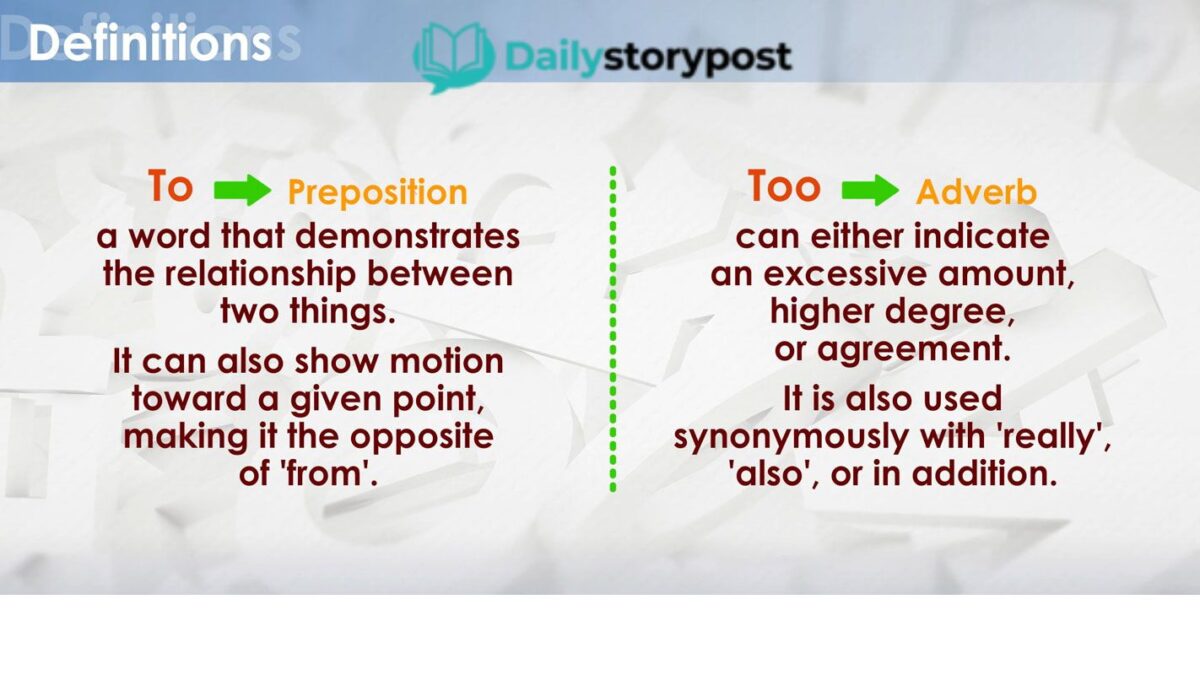
To is a preposition that can be used in several ways. It can indicate a goal, direction, movement, or destination.
For example:
- I am going to class tomorrow.
- We drove to the city.
- Please give this book to Sarah.
The word to is also used before a verb to form an infinitive.
Examples include:
- I want to learn English.
- She plans to travel next year.
- They need to finish the project.
To can also show relationships between words, including possession, attachment, or connection.
Examples:
- She is very attached to her family.
- This bag belongs to me.
It can also indicate a range or period of time:
- The store is open from nine to five.
- The trip will take five to ten minutes.
How to Use Too
Too is an adverb and has two common meanings.
First, it can mean also, as well, or in addition.
Examples:
- I want to come too.
- She likes chocolate too.
- We are going too.
Second, too can mean excessively or more than necessary.
Examples:
- The coffee is too hot.
- This bag is too heavy.
- The movie was too long.
In some casual expressions, too can also be used to emphasize something.
For example:
- That cat is too funny!
To, Too, and Two: Homophones
To, too, and two are pronounced the same in standard English, but they have different spellings and meanings. Words that share the same pronunciation but have different meanings and spellings are called homophones.
Here is the basic difference:
- To — commonly shows direction, connection, or comes before a verb.
- Too — means “also” or “excessively.”
- Two — refers to the number 2.
Other common examples of homophones include there, their, and they’re, as well as your and you’re.
Because these words sound alike, they can easily be confused when writing.
How to Remember the Difference Between To and Too
Since to and too sound the same, the easiest way to remember their spelling is to focus on their meaning.
If too can be replaced with also, as well, or excessively, you should use too with the extra “o.”
For example:
- I want to come too.
→ I want to come also. - The water is too cold.
→ The water is excessively cold.
The extra “o” in too can remind you that it often refers to something extra or additional.
For most other uses, especially when showing direction or placing to before a verb, use the single-o spelling.
Examples of To vs. Too
Here are some simple examples:
- I plan to explore the city.
- This song is dedicated to my friend.
- She would like to play another round.
- The distance was one to three miles.
- The tea was too sweet.
- I want to see the mountains too.
- Our parents came too.
- She tried to win, but it was too little, too late.
Quick Comparison
To is generally used for direction, destination, relationships, ranges, and infinitive verbs.
Too is generally used when you mean “also” or “excessively.”
Two is used only when referring to the number 2.
Understanding these simple differences makes it much easier to choose the correct word when writing. When you are unsure, check the meaning of the sentence rather than relying on pronunciation.
FAQs
1. What is the main difference between “to” and “too”?
“To” is commonly used as a preposition or before a verb, while “too” usually means “also” or “excessively.”
2. When should I use “to” in a sentence?
Use “to” for direction, movement, relationships, time ranges, or to form an infinitive verb. For example, “I want to go to school.”
3. When should I use “too”?
Use “too” when you mean “also,” “as well,” or “excessively.” For example, “I want to come too” or “The coffee is too hot.”
4. Are “to,” “too,” and “two” pronounced the same?
Yes. They are homophones because they have the same pronunciation but different spellings and meanings.
5. What is an easy way to remember “to” vs. “too”?
Remember that “too” has an extra “o.” It can often be replaced with “also” or “excessively,” which helps identify when to use it.