
Technology
How to Build a Startup Booted Fundraising Strategy


Building a startup is exciting, but finding the right funding can become one of the most challenging parts of the journey. A good idea alone is rarely enough to convince investors. Founders need a clear understanding of how much money they need, why they need it, how they plan to use it, and what the business can achieve with that capital.
A startup booted fundraising strategy can help founders approach fundraising in a more organized way. Instead of contacting investors without a clear plan, founders can prepare their finances, define realistic milestones, identify suitable funding sources, and build relationships with investors who understand their market.
Fundraising is also not simply about getting the largest possible investment. The funding structure can affect ownership, decision-making, future fundraising, and the long-term direction of the company. The U.S. Small Business Administration notes that different funding choices can affect how a business is structured and operated, which makes preparation especially important.
BIO
| Label | Information |
|---|---|
| Topic | Startup Fundraising |
| Strategy | Startup Booted Fundraising Strategy |
| Main Purpose | Plan and manage startup funding |
| Funding Goal | Define the capital needed |
| Key Focus | Business growth and financial planning |
| Funding Sources | Angels, venture capital, grants, and crowdfunding |
| Investor Pitch | Explain the problem, solution, and market |
| Financial Plan | Track costs, revenue, and cash flow |
| Investor Research | Find investors that fit the startup |
| Equity | Understand ownership and dilution |
| Key Milestones | Set clear and measurable targets |
| Common Risk | Raising too early, too late, or without a plan |
Understand Your Startup’s Funding Needs
The first step is knowing exactly why your startup needs money.
Some startups need capital to build a product, while others need funding for hiring, marketing, equipment, technology, inventory, or expansion. A founder should be able to explain the purpose of the requested capital without relying on vague statements.
Start by listing your expected expenses. Divide them into essential and optional costs. Essential expenses might include salaries, software, product development, legal costs, manufacturing, or customer acquisition. Optional spending can be reviewed later if the initial funding target needs to be reduced.
It is also useful to calculate your expected cash runway. Runway estimates how long the startup can continue operating before it needs additional capital, based on its current cash position and spending rate.
For example, if a startup has $300,000 available and expects to spend approximately $50,000 per month, its simple operating runway would be around six months. A real calculation should account for expected revenue, changes in expenses, and unexpected costs.
The goal is not to produce a perfect prediction. The goal is to understand the financial position well enough to make sensible decisions.
Define Your Fundraising Goals
Once you know how much money the business needs, connect that amount to specific business goals.
Instead of saying, “We need $1 million to grow,” explain what the capital is expected to accomplish.
The funding might allow the company to:
- Complete product development
- Hire key employees
- Reach a specific number of customers
- Expand into another market
- Increase production capacity
- Improve technology
- Build a sales team
- Reach defined revenue milestones
This makes the fundraising request easier to understand because investors can see the connection between the money and the company’s planned progress.
The SBA recommends that funding requests explain how the money will be used and connect financial projections with the funding requirement.
A strong fundraising goal therefore has three parts: the amount required, the purpose of the funding, and the milestones expected after receiving it.
Choose the Right Funding Method
Not every startup needs venture capital. The right financing method depends on the business model, growth plans, risk level, and founder’s objectives.
Bootstrapping
Bootstrapping means using the founder’s own resources or business revenue to finance growth. It can allow founders to retain more control, but it also means taking on more financial risk personally.
The SBA describes self-funding as an approach that can preserve business control while placing the financial risk largely on the founder.
For businesses that can reach customers quickly and generate revenue without large upfront costs, bootstrapping may be practical.
Angel Investors
Angel investors are individuals who invest their own money in startups. They may also bring industry knowledge, connections, and experience.
However, founders should research potential investors carefully. Money is not the only consideration. An investor’s expectations, experience, involvement, and network can influence the relationship after the investment.
Venture Capital
Venture capital is generally designed for companies with significant growth potential. In exchange for capital, investors normally receive an ownership interest.
The SBA notes that venture capital differs from traditional financing because it generally involves equity rather than a loan and may involve investor participation in company decisions.
That means founders should consider not only how much capital they receive but also how much ownership and control they give up.
Crowdfunding and Grants
Crowdfunding can provide another route, particularly for products that appeal to a large community of potential customers.
Grants can also be useful where the startup qualifies for them. Unlike equity investment, some grants do not require giving investors ownership, although they often come with specific eligibility requirements and restrictions.
The important point is to compare funding methods rather than assuming that venture capital is automatically the answer.
Prepare Your Startup Before Fundraising
Fundraising should ideally begin before the company urgently needs money.
Investors are likely to ask questions about the product, customers, market, financial performance, team, and business model. Preparing these areas early makes conversations much easier.
A startup should organize important documents such as:
- Financial statements
- Revenue information
- Customer data
- Ownership records
- Business formation documents
- Intellectual property information
- Contracts
- Employee information
- Product information
- Growth metrics
This preparation is especially important because investors may conduct due diligence before completing an investment.
According to the SBA, venture investors may review areas including the management team, market, products and services, corporate governance documents, and financial statements.
Good preparation can also reveal weaknesses before investors discover them.
Create a Strong Investor Pitch
A pitch should explain the business clearly without making the presentation unnecessarily complicated.
Start with the problem.
What problem does the customer have, and why does it matter?
Then explain the solution.
What does the startup provide, and why is it useful?
Next, describe the market.
Who are the customers? How large is the opportunity? What trends support the business?
After that, explain the business model.
How does the company make money? What are its main revenue sources? What does it cost to acquire and serve customers?
Traction is also important. Depending on the startup, traction could include revenue, customer growth, product adoption, partnerships, retention, or other meaningful indicators.
Finally, explain the fundraising request.
Investors should understand how much you are raising, how the money will be used, and what milestones the company expects to reach.
Build an Effective Fundraising Strategy
A successful fundraising process requires organization.
Create a list of potential investors and record useful information about each one. Consider their investment stage, industry interests, typical investment size, geographic focus, and previous portfolio companies.
Not every investor will be appropriate for every startup.
Research can prevent founders from spending valuable time approaching investors whose investment criteria do not match the business.
It can also help founders personalize their communication. A short, relevant introduction is generally more useful than sending the same generic message to hundreds of investors.
Create a fundraising timeline as well. Decide when investor outreach will begin, when meetings will take place, when documents should be ready, and when you ideally want to close the round.
A timeline helps prevent fundraising from becoming an endless distraction from running the company.
Know Your Valuation and Equity
Founders should understand the relationship between fundraising, valuation, and ownership before accepting an investment.
If investors receive equity, existing shareholders may experience dilution. The percentage ownership held by founders can decrease as new shares or equivalent rights are issued.
Early-stage startups may also use instruments such as SAFEs or convertible notes rather than completing a traditional priced equity round.
A SAFE, or Simple Agreement for Future Equity, gives an investor the right to receive shares in a future financing event rather than issuing those shares immediately. Y Combinator explains that a SAFE can include terms such as a valuation cap or discount, and founders should understand how those terms affect future ownership.
For example, a valuation cap can affect the price at which a SAFE converts into equity. The precise financial effect depends on the terms and future financing.
This is why founders should understand the numbers rather than focusing only on the headline amount being invested.
Develop a Clear Financial Plan
Investors need more than an exciting idea. They need to understand the financial side of the business.
A financial plan can include:
- Current revenue
- Monthly expenses
- Cash balance
- Gross margins
- Customer acquisition costs
- Expected revenue growth
- Hiring plans
- Capital requirements
- Cash-flow projections
Forecasts should be realistic.
It is easy to create a spreadsheet showing rapid growth, but unrealistic assumptions can weaken credibility when investors start asking questions.
The SBA recommends connecting financial projections to the funding request and providing sufficient detail to explain how the projections were developed.
For an early-stage startup, assumptions may change frequently. That is normal. What matters is that the founder understands those assumptions and can explain why they were chosen.
Build Relationships With Potential Investors
Fundraising is often easier when relationships are developed before the formal investment process begins.
Founders can meet potential investors through industry events, startup communities, professional networks, accelerators, introductions from other founders, and relevant business contacts.
The purpose should not always be to immediately ask for money.
A conversation can instead focus on the market, the product, customer problems, or the founder’s plans. Over time, this can create familiarity and make future fundraising conversations more natural.
Y Combinator has also emphasized the importance of customer engagement, growth, mission, and clearly explaining why a company can become strategically valuable when communicating with investors.
The strongest relationship is not necessarily the one that produces the fastest check. It is one where expectations, communication styles, and business interests are reasonably aligned.
Understand the Terms Beyond Valuation
Founders sometimes focus heavily on valuation while overlooking other investment terms.
That can be a mistake.
A term sheet can address issues involving ownership, control, liquidation preferences, board rights, investor protections, and other conditions.
Y Combinator’s Series A term-sheet guidance specifically highlights that terms involving control and deal structure can be important areas for founders to understand, not simply the headline valuation.
For example, a liquidation preference can affect how proceeds are distributed during an exit. Board provisions can affect decision-making. Other rights can influence future financing.
Because these agreements can have long-term consequences, founders should have qualified legal and financial professionals review documents before signing them.
Avoid Common Fundraising Mistakes
One common mistake is raising without a clear purpose.
If the founder cannot explain what the money will accomplish, investors may question the underlying plan.
Another problem is raising too late. When a startup has very little cash remaining, the founder may have less time and negotiating flexibility.
Approaching every investor with the same message can also waste time. Investors have different strategies, industries, stages, and requirements.
Poor financial records are another avoidable issue. If basic numbers are difficult to verify, the due-diligence process can become unnecessarily complicated.
Founders should also avoid exaggerating market size or presenting unrealistic forecasts.
A strong fundraising strategy does not require pretending that every number is perfect. It requires understanding the numbers and being prepared to discuss the assumptions behind them.
Measure Fundraising Progress
Fundraising should be treated like a process that can be measured.
Keep track of:
- Investors contacted
- Responses received
- Introductory meetings
- Follow-up meetings
- Due-diligence requests
- Term-sheet discussions
- Investment commitments
- Total capital raised
These figures can help founders identify where the process is slowing down.
For example, if investors are taking meetings but repeatedly questioning the same part of the business, that feedback may indicate an area that needs clearer explanation.
If very few investors respond, the issue could be the investor targeting, outreach approach, startup stage, market positioning, or simply timing.
The goal is to use the information to improve the process rather than repeatedly sending the same pitch.
Consider the Fundraising Environment
The broader investment environment can also affect fundraising.
For example, the National Venture Capital Association’s 2026 Yearbook, using PitchBook data, reported that U.S. venture funds raised about $67 billion across 585 funds in 2025, down substantially from the unusually high fundraising levels seen during 2020–2022.
Its Q1 2026 Venture Monitor reported $47.8 billion raised across 172 funds during the first quarter of 2026, while noting that a small number of large managers accounted for a very large share of the capital raised.
These figures describe venture-fund fundraising rather than the amount individual startups receive, so founders should not treat them as a direct prediction of their own fundraising prospects.
Still, they illustrate why startup founders should pay attention to market conditions and avoid building a plan around the assumption that capital will always be equally available.
Know When to Raise More Money
A startup does not necessarily need to raise another round simply because it has the opportunity.
The decision should be connected to the company’s financial position and development.
Before raising additional capital, founders can ask:
How much runway remains?
What milestones have been achieved?
What milestones require additional funding?
Has the business model changed?
What will the new capital accomplish?
What ownership or control will be exchanged for the funding?
The answers can help determine whether additional capital is actually needed.
A company that has achieved meaningful traction may be able to approach investors with stronger evidence than it had during its previous round. On the other hand, a startup facing immediate cash pressure may have fewer options.
Planning ahead gives founders more time to evaluate their choices.
A Practical Fundraising Roadmap
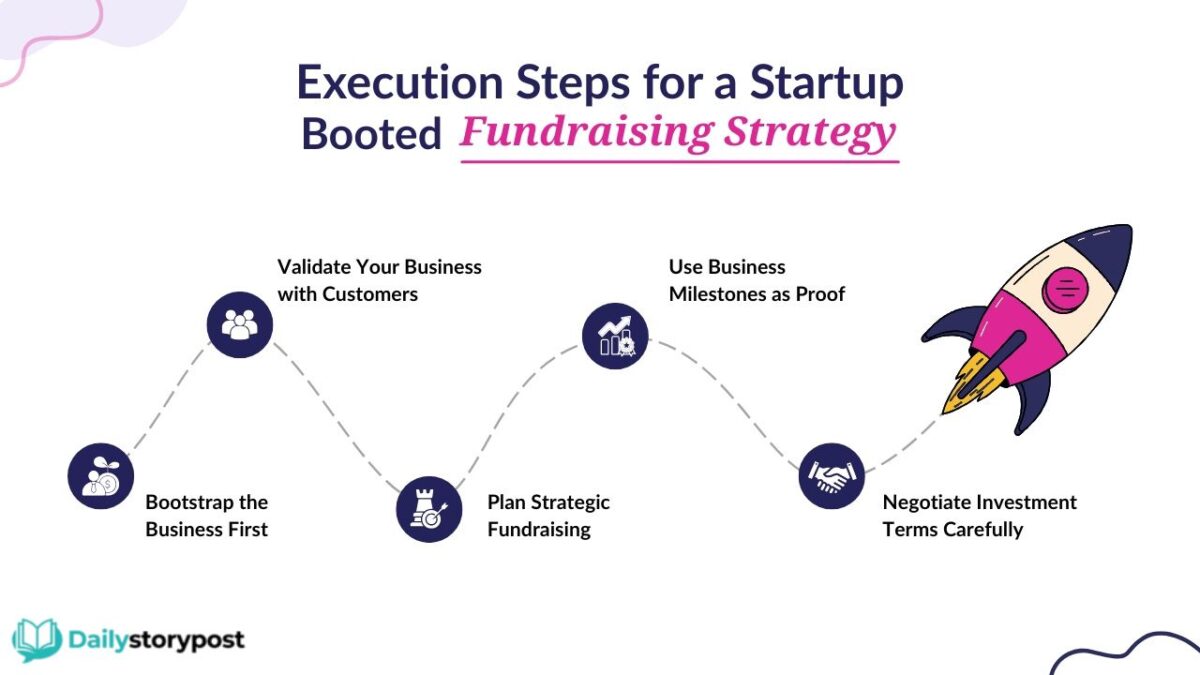
A simple startup booted fundraising strategy can be organized into several stages.
Stage 1: Financial preparation.
Calculate expenses, runway, funding requirements, and expected milestones.
Stage 2: Business preparation.
Strengthen the product, customer evidence, business model, financial records, and company documentation.
Stage 3: Investor research.
Build a list of investors whose investment interests match the startup.
Stage 4: Outreach.
Begin conversations with clear, personalized communication.
Stage 5: Pitch and meetings.
Explain the problem, solution, market, business model, traction, team, and fundraising request.
Stage 6: Due diligence.
Provide accurate documents and respond clearly to investor questions.
Stage 7: Deal terms.
Review the proposed investment structure carefully, including ownership and control provisions.
Stage 8: Closing and execution.
Complete the required legal documentation and focus on achieving the milestones that justified the fundraising round.
This approach keeps fundraising connected to the actual operation of the company.
Final Thoughts
Building a startup booted fundraising strategy is about much more than finding investors. It is about understanding the business well enough to explain its financial needs, growth opportunities, risks, and plans clearly.
A founder should begin with a realistic funding requirement, define measurable goals, choose appropriate financing options, prepare reliable financial information, and research potential investors carefully.
The fundraising process also becomes more manageable when founders understand valuation, dilution, investment structures, due diligence, and deal terms before negotiations begin.
Most importantly, fundraising should support the company’s broader strategy rather than becoming the strategy itself. Capital is useful when it helps a startup reach meaningful milestones, develop its product, serve customers, and build a sustainable business.
By approaching the process with preparation, clear numbers, realistic expectations, and strong investor relationships, founders can create a fundraising plan that fits the actual needs of their startup.
FAQs
1. What is a startup booted fundraising strategy?
A startup booted fundraising strategy is a structured plan for deciding how much funding a startup needs, where to find it, and how the money will support business growth.
2. How much funding should a startup raise?
The amount depends on the startup’s expenses, runway, growth plans, and upcoming milestones. Founders should raise enough to reach meaningful goals without unnecessarily giving up equity.
3. What should a startup include in its investor pitch?
A strong pitch should explain the problem, solution, target market, business model, traction, team, financial outlook, and the amount of funding being requested.
4. How can founders find suitable investors?
Founders can research investors based on their industry interests, investment stage, typical deal size, and previous portfolio companies. Professional networks and introductions can also help.
5. When should a startup begin fundraising?
Ideally, fundraising should begin before the startup faces an immediate cash shortage. Early preparation gives founders more time to research investors and organize their financial and business information.

When people search for thestripesblog Frank Fisher, they are usually trying to understand who Frank Fisher is, what he does for The Stripes Blog, and why his name appears across so many articles on the website.
Frank Fisher is publicly presented as a member of The Stripes Blog team and an author whose work appears on the site. The website’s team information describes him as a passionate gamer with a strong interest in cryptocurrency. His published work, however, covers a much wider range of subjects, including technology, business, travel, gaming, sports, and practical digital topics.
That broader writing history is important because it gives a better picture of Fisher’s role than a short biography alone. Rather than being associated with just one subject, his name appears alongside articles covering different areas of interest. His work reflects the broad editorial direction of The Stripes Blog and its effort to publish material for readers with different interests.
BIO
| Label | Information |
|---|---|
| Name | Frank Fisher |
| Known For | Writing and online publishing |
| Associated With | The Stripes Blog |
| Role | Writer and team member |
| Main Interest | Gaming |
| Other Interest | Cryptocurrency |
| Gaming Topics | Reviews, guides, and industry updates |
| Writing Areas | Technology, business, and travel |
| Content Type | Informative articles and guides |
| Online Presence | Published work on The Stripes Blog |
| Personal Details | Limited public information |
| Writing Focus | Practical and general-interest topics |
Who Is Frank Fisher?
Frank Fisher is a writer and team member associated with The Stripes Blog, an online publication that covers a variety of subjects. The site’s own team page identifies Fisher and describes his interests in gaming and cryptocurrency. It also connects him with gaming reviews, guides, and industry-related content.
His author archive provides another useful look at his work. Articles under his name include subjects such as travel, digital tools, gaming, business, technology, and practical guides. This suggests that his role on the website extends beyond a single specialist category.
For readers searching thestripesblog Frank Fisher, this distinction matters. There is a difference between information that comes directly from a publication’s own author and team pages and claims repeated by unrelated websites. The most reliable starting point is therefore the information published by The Stripes Blog itself.
Publicly available information about Fisher’s private life is limited. There is not a detailed personal biography on the site’s team page covering every aspect of his childhood, education, family life, or personal history. For that reason, those details should not be presented as established facts without stronger sources.
Frank Fisher and The Stripes Blog
The Stripes Blog describes itself as a publication that brings together different areas of online content. Its website has featured material related to sports, entertainment, gaming, technology, travel, business, and other subjects. The site’s team page describes the publication as combining sports, gaming, and travel while also highlighting its wider editorial range.
Frank Fisher appears to be one of the recurring names behind this content. His author page contains numerous articles published under his name, showing that he has contributed regularly rather than appearing only on a single article.
One of the clearest areas associated with Fisher is gaming. The Stripes Blog’s team description specifically highlights his enthusiasm for video games and his interest in developments within the gaming industry. According to the site, this interest is reflected in gaming reviews, guides, and industry updates.
His published material also shows that his interests are not limited to gaming. Articles attributed to him have covered topics ranging from cryptocurrency and business to travel and technology. This variety is consistent with the broad subject range found across The Stripes Blog.

His Writing and Professional Interests
A look through Fisher’s published work gives readers a more practical understanding of his role.
Gaming is one of the most visible areas. An article published under his name discusses changes in the gaming industry and examines developments such as cloud gaming and technological changes affecting the way people play.
His work also includes cryptocurrency-related subjects. The Stripes Blog has published articles under Fisher’s name discussing crypto portfolios, trading, wallets, and related financial technology topics. These articles show an interest in explaining digital financial concepts to a general audience rather than limiting the discussion to specialist readers.
Technology is another recurring subject. His author archive includes articles involving digital tools, online services, telephony integration, and other technology-related topics.
Travel is also represented in his work. The author archive includes pieces about destinations and travel experiences, including an article about Serra da Estrela in Portugal and other travel-related guides.
This mixture of subjects suggests that Fisher’s contribution is best understood as broad digital publishing rather than a narrowly defined specialist career.
Why His Name Appears on So Many Topics
A common question behind the search thestripesblog Frank Fisher is why the same author name appears across such different subjects.
The answer can be seen in The Stripes Blog’s publishing structure. The site operates across several categories, and its author archive contains articles addressing different interests. A contributor working within such a publication may write about multiple categories rather than focusing on only one professional field.
For example, Fisher’s name appears on content related to gaming, crypto, business, travel, and technology. His archive therefore provides a broader picture of his contribution than any individual article can provide.
This also explains why someone may first discover Fisher through a gaming article and later encounter his name on a technology or travel piece. His published work crosses several sections of the site.
His Interest in Gaming
Gaming appears to be one of the strongest identifiable interests connected with Frank Fisher.
The Stripes Blog’s team page specifically describes him as a passionate gamer and says that his enthusiasm for video games informs his contributions to the site’s gaming coverage. The site associates him with reviews, gaming guides, and industry updates.
That description is supported to some extent by the site’s published archive. Fisher’s name appears on gaming-related articles, including material discussing industry trends and troubleshooting issues in games.
Gaming writing can take several forms. A review may focus on a player’s experience, while a guide generally aims to solve a particular problem. Industry articles, meanwhile, examine broader developments such as new technologies, changing player habits, or evolving business models.
Fisher’s published work includes elements of these different approaches, giving readers practical information as well as general discussion about the gaming industry.
His Interest in Cryptocurrency
Cryptocurrency is another area specifically mentioned in the site’s description of Frank Fisher.
The Stripes Blog says Fisher has an interest in cryptocurrency and connects this interest with his wider work. His published articles have included subjects such as crypto portfolios, trading tools, and cryptocurrency wallets.
This is significant because cryptocurrency can be difficult for new readers to understand. Terms involving wallets, trading, decentralized exchanges, and digital assets can quickly become technical.
Articles written for a general audience can make these subjects easier to approach by explaining concepts in practical language. Fisher’s crypto-related contributions fit into this broader educational style of online publishing.
Readers should still distinguish between an informational article and professional financial advice. Cryptocurrency remains a complex and volatile area, so individual articles should be read as general information rather than a substitute for independent financial research.
A Broader Range of Topics
Although gaming and cryptocurrency stand out in the site’s description of Fisher, his published work demonstrates a much broader range.
His author archive includes articles about travel, technology, business services, digital tools, automobiles, and online entertainment.
One article focuses on traveling through Serra da Estrela in Portugal, while another discusses considerations for buying a boat in New York. Other pieces examine casual online games, digital travel tools, telephony integration, and luxury car rentals.
This variety is useful when considering Fisher’s position as a digital writer. His work is not confined to one narrow subject. Instead, he contributes content designed for readers searching for answers, explanations, guides, and general-interest information.
What Is Known About His Background?
There is an important limitation when researching Frank Fisher’s personal background: the publicly available information is much stronger on his professional connection to The Stripes Blog than on his private biography.
The site’s current team information provides details about his interests and contribution to the publication, but it does not offer an extensive account of his childhood, family, education, or personal life.
That means readers should be cautious with detailed biographies published elsewhere unless those claims can be independently verified.
Several third-party websites make additional claims about Fisher’s education, previous employers, social-media following, and personal history. However, those claims are not established by the primary team and author information reviewed for this article. For a factual biography, it is better to separate confirmed information from repeated internet claims.
This approach also makes the story more useful for readers. Instead of filling gaps with speculation, it focuses on what can actually be established from published material.
His Role as an Online Writer
Frank Fisher’s work illustrates how modern online publishing can involve a wide range of subjects.
A writer for a general-interest website may need to move between different topics while maintaining a clear and accessible style. One day the subject may be a gaming problem; another article may focus on cryptocurrency, travel, technology, or business.
Fisher’s author archive reflects this type of publishing model. His name appears on articles written for readers looking for practical information and straightforward explanations.
The approach also explains why his name can become associated with different search terms. Readers may encounter his work through completely different categories and then search his name to learn more about the person behind the articles.
Why Readers Search for Frank Fisher
The phrase thestripesblog Frank Fisher appears to be driven primarily by curiosity about the person connected with the website.
Someone may have read an article bearing his name and want to know whether he is a journalist, editor, blogger, specialist, or member of the site’s wider team. Others may simply want to understand the background of an author whose name appears repeatedly across The Stripes Blog.
The site’s own information provides the clearest answer: Frank Fisher is presented as a member of the team, with particular interests in gaming and cryptocurrency, while his author archive demonstrates a broader publishing role.
That combination makes him more than an isolated byline. His name is connected to a substantial collection of articles across multiple categories.
What Readers Can Learn From His Work
One useful feature of Fisher’s published work is its range.
Readers interested in gaming can find guides and industry-related discussions. People interested in cryptocurrency can find articles covering different aspects of the digital-asset world. Other readers may encounter his work through travel, business, technology, or lifestyle-related subjects.
This range can make an author’s archive useful even when a reader arrives looking for only one particular topic.
It also shows how online writers increasingly work across subject boundaries. Digital audiences often want information that is quick to understand but still useful enough to answer a specific question. General-interest writers frequently adapt their research and writing to meet those different needs.
Important Facts About Frank Fisher
The most reliable facts that can currently be drawn from The Stripes Blog’s own published information include:
- Name: Frank Fisher
- Association: The Stripes Blog
- Role: Listed member and author
- Major stated interest: Gaming
- Other stated interest: Cryptocurrency
- Gaming work: Reviews, guides, and industry updates
- Published subjects: Gaming, technology, business, travel, crypto, and other topics
- Writing presence: Multiple articles appear under his author name
- Public biography: Limited compared with his published professional work
These points provide a useful overview without adding unsupported personal details.
What Is Not Clearly Confirmed?
A good article about a relatively private online writer should also explain what remains uncertain.
There is no strong basis in the primary material reviewed here for confidently stating detailed information about Frank Fisher’s exact age, birthplace, family, marital status, formal education, or previous employment history.
Likewise, claims about very large social-media audiences or prestigious previous positions should not automatically be accepted simply because they appear on several websites. Repetition does not necessarily make a claim independently verified.
For readers, this is an important distinction. A responsible profile should identify the difference between published facts and internet speculation.
In Fisher’s case, his connection with The Stripes Blog and his published work can be established much more clearly than many details about his private life.
Frank Fisher’s Online Presence
The most visible professional presence associated with Fisher is his work on The Stripes Blog.
His author archive contains multiple articles, making it possible to understand his interests through his published work rather than relying entirely on a short biography.
The site also has a team page that provides additional context about his interests and role. Together, these two sources offer a clearer picture than many third-party summaries.
For readers researching thestripesblog Frank Fisher, checking the author’s actual published material is particularly useful. It shows what topics he has covered and how his role fits into the wider publication.
Final Thoughts
Frank Fisher is best understood as a writer and team member associated with The Stripes Blog, with a particular connection to gaming and cryptocurrency and a much broader body of published work.
The Stripes Blog itself describes Fisher as a passionate gamer and cryptocurrency enthusiast, while his author archive demonstrates contributions across technology, business, travel, gaming, and other areas.
What makes the thestripesblog Frank Fisher search interesting is that there is more information about his work than there is about his private life. His published articles provide a practical record of his interests and contributions, while the available team information gives readers some context about his role.
At the same time, readers should be careful with detailed biographical claims that are not supported by primary sources. When information about a writer is limited, sticking to verified professional details is a better approach than filling gaps with assumptions.
Ultimately, Frank Fisher’s online identity is closely connected with the content he has published for The Stripes Blog. His work across gaming, cryptocurrency, technology, travel, and other subjects shows the broad nature of modern digital writing and explains why his name appears in searches across several different topics.
Frequently Asked Questions
Who is Frank Fisher?
Frank Fisher is a writer and team member associated with The Stripes Blog. The site’s team page highlights his interest in gaming and cryptocurrency, while his author archive shows contributions across several subjects.
What is Frank Fisher known for on The Stripes Blog?
He is particularly associated with gaming-related content and cryptocurrency, although his published work covers many additional subjects, including technology, travel, business, and digital services.
Does Frank Fisher write about gaming?
Yes. The Stripes Blog specifically describes him as a passionate gamer and connects his work with gaming reviews, guides, and industry updates.
Does Frank Fisher cover cryptocurrency?
Yes. Cryptocurrency is specifically mentioned among his interests, and articles under his name have covered crypto-related subjects and tools.
Is detailed personal information about Frank Fisher publicly available?
Only limited personal information is clearly established by the primary sources reviewed. His professional connection to The Stripes Blog and his published work are much easier to verify than details about his private life.
What subjects does Frank Fisher write about?
His published work includes gaming, cryptocurrency, technology, business, travel, digital tools, and other general-interest subjects. His author archive demonstrates a considerably wider range than gaming alone.
Who is Frank Fisher?
Frank Fisher is a writer and team member associated with The Stripes Blog. His work covers several topics, with gaming and cryptocurrency among his stated interests.
What does Frank Fisher write about?
His published work covers gaming, cryptocurrency, technology, travel, business, and other digital topics, showing a broad range of interests.
Is Frank Fisher connected to The Stripes Blog?
Yes. The Stripes Blog lists Frank Fisher as part of its team and publishes articles under his name.
What is Frank Fisher interested in?
According to The Stripes Blog, Fisher has a particular interest in gaming and cryptocurrency. These interests are also reflected in some of his published work.
Is Frank Fisher’s personal life publicly known?
Only limited personal information is clearly available from primary sources. Most publicly documented information concerns his writing and connection with The Stripes Blog.

Exploring the London, a city renowned for its rich history, culture, and economic prowess, has also become a significant hub for technological advancements and IT services. As the digital age continues to evolve, the demand for IT services in London has surged, making it an essential sector that supports businesses of all sizes and industries. In this blog, we will delve into the various aspects of IT services in London, highlighting their importance, types, and the key players driving the industry forward.
BIO
| Label | Information |
|---|---|
| Topic | IT Services in London |
| Location | London, UK |
| Main Services | Managed IT, cybersecurity, cloud computing |
| IT Support | Remote and on-site support |
| Managed Services | Network, backup, recovery, and support |
| Cybersecurity | Threat protection and security measures |
| Cloud Services | Remote data and application access |
| IT Consulting | Technology planning and strategy |
| Technical Support | Hardware and software troubleshooting |
| Key Providers | AGN IT Services, Capgemini, Cognizant |
| Emerging Technology | AI, blockchain, and IoT |
| Business Benefits | Productivity, security, and continuity |
| Future Outlook | Growing demand for digital IT solutions |
The Importance of IT Services in London
IT services in London play a crucial role in the daily operations of businesses. From ensuring smooth network functionality to providing cybersecurity solutions, these services are indispensable. In a city where competition is fierce, having reliable IT support can be the difference between success and failure. Companies rely on IT services to maintain their digital infrastructure, which includes hardware, software, and networking components. This reliance ensures business continuity, enhances productivity, and provides a competitive edge in the market.
Types of IT Services in London
The landscape of IT services in London is diverse, catering to various needs and requirements of businesses. Here are some of the key services offered:
1. Managed IT Services
Managed IT services are comprehensive solutions that cover all aspects of a company’s IT needs. These services include network management, data backup, disaster recovery, and IT support. By outsourcing these functions to a managed service provider, businesses can focus on their core activities while ensuring their IT infrastructure is in expert hands.
2. Cybersecurity Services
In today’s digital world, cybersecurity is paramount. IT services in London offer robust cybersecurity solutions to protect businesses from cyber threats such as hacking, phishing, and malware attacks. These services include risk assessments, security audits, and the implementation of advanced security measures to safeguard sensitive information.
3. Cloud Computing Services
Cloud computing has revolutionized the way businesses operate. IT services in London provide cloud solutions that enable companies to store, manage, and access data remotely. This flexibility not only reduces costs associated with physical storage but also enhances collaboration and scalability.
4. IT Consulting Services
IT consulting services help businesses develop and implement IT strategies that align with their goals. Consultants provide expert advice on technology investments, infrastructure improvements, and digital transformation initiatives, ensuring businesses stay ahead of technological trends.
5. Technical Support Services
Technical support is a vital aspect of managed IT services in London. Whether it’s troubleshooting software issues or resolving hardware problems, technical support teams ensure that businesses experience minimal downtime. This support can be provided on-site or remotely, depending on the needs of the business.
Key Players in IT Services in London
The market for IT services in London is populated by numerous providers, each offering unique solutions. Some of the key players include:
1. AGN IT Services

AGN IT Services is a global leader in IT services, providing a wide range of solutions, including digital transformation, cybersecurity, and cloud services. With a strong presence in London, AGN IT Services helps businesses leverage technology to achieve their objectives.
2. Capgemini
Capgemini is another major player in the IT services industry. They offer services such as consulting, technology, and outsourcing. Their expertise in digital transformation and innovation makes them a preferred choice for many businesses in London.
3. Cognizant
Cognizant specializes in IT services that drive digital business transformations. Their offerings include application development, IT infrastructure services, and data analytics. Cognizant’s focus on customer-centric solutions has earned them a strong reputation in London.
The Future of IT Services in London
As technology continues to advance, the future of IT services in London looks promising. Emerging technologies such as artificial intelligence, blockchain, and the Internet of Things (IoT) are set to transform the IT landscape. Businesses will increasingly rely on IT services to integrate these technologies into their operations, driving innovation and efficiency.
Furthermore, the ongoing shift towards remote work and digital collaboration is expected to boost the demand for IT services in London. Companies will need robust IT infrastructures and support systems to facilitate seamless remote operations and ensure data security.
Conclusion
In conclusion, IT services in London are a cornerstone of the city’s business ecosystem. From managed services to cybersecurity and cloud computing, these services are vital for the smooth operation and growth of businesses. The presence of leading IT service providers further enhances the quality and reliability of these services. As technology evolves, the role of IT services in London will only become more significant, driving innovation and efficiency across industries.
Whether you are a small business looking to streamline your IT operations or a large corporation seeking to enhance your digital capabilities, the diverse and dynamic landscape of IT services in London has something to offer. Embrace the technological advancements and partner with a reputable IT service provider to stay ahead in this competitive market.

In the world of donations, finding the perfect image for your slides can be frustrating. Most people waste hours searching through stock libraries or struggle to edit illustrations to match their themes. That’s where AiPPT Nano Banana steps in — an innovative, free AI image creator from AiPPT designed to fully change the way you produce illustrations for your PowerPoint presentations.
BIO
| Label | Information |
|---|---|
| Tool Name | Nano Banana |
| Platform | AiPPT |
| Tool Type | AI Image Generator |
| Main Purpose | Create PPT visuals |
| Image Creation | AI-powered |
| Image Editing | Supported |
| Presentation Use | PowerPoint slides |
| Customization | Colors, sizes, styles |
| Design Skills | Not required |
| Key Benefit | Saves time |
| Creative Value | Boosts visual creativity |
| Best For | Presenters, marketers, educators |
What Is Nano Banana?
Nano Banana is AiPPT’s advanced AI-powered image tool that helps users instantly generate and edit custom presentation illustrations. Instead of browsing endless image libraries, you can now produce unique, high-quality images directly within the AiPPT ecosystem. This tool turns your ideas into stunning, presentation-ready illustrations — saving time and boosting creativity.
With Nano Banana, you’re not just editing slides; you’re enhancing stories, boosting engagement, and building visual impact effortlessly.
The Problem: Finding the Right Illustrations for Slides
Creating professional presentations frequently hits one major obstacle — illustrations. Whether it’s a product image, infographic, or creative background, most presenters rely on repetitive stock photos or complex editing tools. This approach not only eats up time but also results in dull, uninspired slides that fail to impress audiences.
That’s the gap Nano Banana fills.
The Solution: AiPPT’s Nano Banana Image Generator

Nano Banana is more than just another PPT image editor. It’s a smart AI tool built specifically for presentation creators. Using advanced AI technology, it generates images that align perfectly with your content and design style.
Here’s how it transforms your workflow:
- Generate Custom Illustrations Instantly
Describe what you need, and Nano Banana creates it in seconds. - Edit and Customize
Adjust colors, sizes, and styles to fit your presentation theme using AiPPT’s intuitive image editor. - Free to Use
Unlike other tools, Nano Banana is fully free within AiPPT, making high-quality image creation accessible to everyone.
You can try the Nano Banana tool for free today and see how quickly it upgrades your slide illustrations.
Why Nano Banana Is a Game-Changer for Presentations
When you use Nano Banana, you’re not just saving time; you’re transforming how your audience perceives your work. With its AI-driven precision, every slide becomes more captivating, polished, and memorable.
Key Benefits:
Professional Look
Achieve design consistency with custom illustrations generated by AI.
Enhanced Creativity
Turn abstract ideas into visual images effortlessly.
No Design Skills Required
Perfect for presenters, marketers, educators, and teams who need results quickly.
In short, Nano Banana helps you create presentations that look like they were designed by professionals — without the hassle or cost.
Final Thoughts: Power Your Slides with Nano Banana
In today’s fast-paced digital world, presentations must stand out visually to make an impact. Nano Banana gives you that edge — a free AI image creator built into AiPPT that lets you craft and customize illustrations that truly elevate your communication.
Start creating smarter and faster and try the Nano Banana tool for free to experience how AiPPT is redefining presentation design.
FAQs
1. What is Nano Banana?
Nano Banana is an AI-powered image creation and editing tool designed to help users create custom visuals for PowerPoint presentations.
2. How can Nano Banana improve PowerPoint presentations?
It can help create customized, presentation-ready images that match your content, theme, colors, and overall slide design.
3. Is Nano Banana easy to use?
Yes. Users can describe the type of image they need and use AI-generated visuals without requiring advanced design skills.
4. Can Nano Banana create custom presentation images?
Yes. The tool is designed to generate custom illustrations and visuals based on the user’s ideas and presentation requirements.
5. Who can benefit from Nano Banana?
Presenters, marketers, educators, students, and teams can use it to create engaging visuals and improve the appearance of their presentations.


 Celebrity4 months ago
How Tall Is Glen Powell? Height, Facts, and More
- Celebrity4 months ago
Fielder Jewett Age: Everything We Know About Him in 2026
- Technology4 months ago
How Simpcitt Is Changing the Way People Think Today
- Celebrity4 months ago
Who Is Meredith Schwarz? Key Facts You Should Know
- Food & Drink4 months ago
Where to Find the Best Piononos de Santa Fe Near Me Today
- Home Safety3 months ago
How KDArchitects Landscape Ideas by Morph Transform Outdoor Spaces
- Business4 months ago
How to Buy Milohacherry Coin Safely and Get Started Today
- Business4 months ago
How Driving Modes in Cadillac Lyriq Impact Range and Efficiency