Lifestyle & Work
How to Find Your Kibbe Body Type With Easy Steps

Finding the right clothes can sometimes feel harder than it should. A garment may look beautiful on someone else but feel completely different when you wear it. That does not necessarily mean the clothing is wrong or that your body needs to change. Sometimes, the issue is simply that the lines, proportions, and shapes of the clothing do not work naturally with your own appearance.
This is where Kibbe body types can offer a different way of thinking about personal style. Developed by image consultant David Kibbe, the system was introduced in his 1987 book Metamorphosis. Instead of concentrating only on measurements such as bust, waist, and hips, Kibbe’s approach looks at the overall relationship between bone structure, body flesh, facial features, proportions, and the visual impression created by the whole person.
The system is often described using the ideas of Yin and Yang. In simple terms, Yin represents softer, rounded, delicate qualities, while Yang represents sharper, longer, stronger, or more angular qualities. The purpose is not to decide which body is better. Instead, it is intended to help people understand which clothing lines create visual harmony with their natural appearance.
If you are new to the system, the terminology can seem complicated. The good news is that you do not need to memorize everything at once. By looking at your overall silhouette and working through a few practical steps, you can begin narrowing down the possibilities.
BIO
| Label | Information |
|---|---|
| Topic | Kibbe Body Types |
| Creator | David Kibbe |
| Main Purpose | Personal style guidance |
| Core Idea | Yin and Yang balance |
| Original Framework | 13 Image Identities |
| Modern Framework | 10 active identities |
| Main Families | Dramatic, Natural, Classic, Gamine, Romantic |
| Key Focus | Overall body lines |
| Important Factors | Structure, width, curve, and vertical |
| Style Goal | Create visual harmony |
| Best Starting Point | Observe your overall silhouette |
| Useful Method | Test different clothing lines |
| Main Benefit | Build a more natural personal style |
What Are Kibbe Body Types?
The original Kibbe system presented 13 Image Identities, arranged across five broad families: Dramatic, Natural, Classic, Gamine, and Romantic. The original list included Dramatic, Soft Dramatic, Flamboyant Natural, Natural, Soft Natural, Dramatic Classic, Classic, Soft Classic, Flamboyant Gamine, Gamine, Soft Gamine, Theatrical Romantic, and Romantic.
There is an important modern distinction to understand. Contemporary discussions of Kibbe often describe the system as having 10 active Image Identities, because the pure Natural, Classic, and Gamine categories have been retired or are treated as legacy categories. However, the original 13-type framework remains widely searched and discussed, so both versions appear in style resources today.
The important point is that Kibbe is not simply another version of the traditional “pear,” “apple,” “rectangle,” or “hourglass” system. Traditional body-shape systems generally emphasize measurements and proportions. Kibbe is more concerned with the way your entire visual structure works together.
That difference matters. Two people can have similar measurements but look very different in clothing because their bone structure, vertical line, width, curve, and overall visual balance are different.
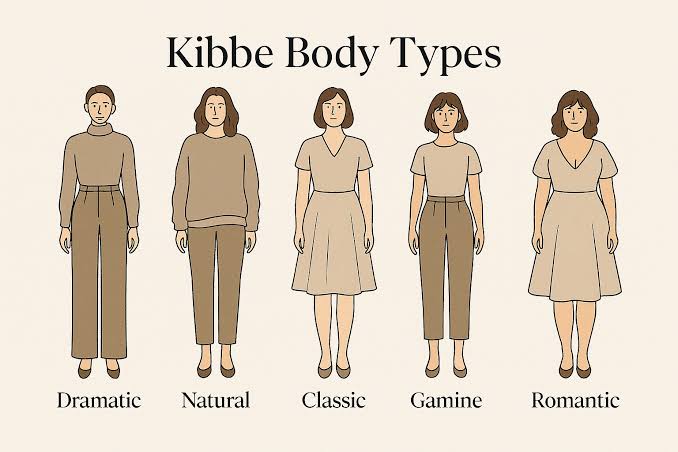
The Five Main Families
The five original Kibbe families provide a useful starting point.
Dramatic is associated with stronger Yang qualities, such as length, sharpness, and angularity.
Natural combines Yang qualities with a broader, more relaxed or blunt structural impression.
Classic represents balance and symmetry between Yin and Yang.
Gamine is known for contrast, combining different qualities rather than presenting one uninterrupted visual direction.
Romantic represents stronger Yin qualities, including softness, rounded shapes, and pronounced curve.
These families are not rankings. Being a Dramatic does not make someone more elegant than a Romantic, and being a Romantic does not make someone more feminine than a Natural. Each identity simply describes a different relationship between physical structure and styling lines.
Start With Your Overall Silhouette
The first step in finding your Kibbe identity is to stop examining individual body parts and look at yourself as a complete silhouette.
Stand naturally in front of a full-length mirror. Wear simple clothing that does not create a strong visual shape of its own. Instead of immediately asking whether you have broad shoulders, wide hips, or a small waist, ask what impression your complete outline creates.
Does your body appear long and uninterrupted?

Does it look broad or open through the shoulders?
Do rounded curves dominate your silhouette?
Does everything appear evenly balanced?
Do you notice a combination of sharp and soft qualities?
These questions are more useful than focusing on a single measurement.
The modern Kibbe approach places considerable importance on Personal Line, which looks at the continuous visual outline created by the body as a whole. Current explanations of the updated system describe Personal Line as a blueprint for how clothing should interact with your proportions.
Examine Your Bone Structure
Your bone structure provides another important clue.
Look at your shoulders, arms, hands, legs, feet, and overall frame. You are not trying to label every feature separately. Instead, consider whether your structure generally appears sharp, blunt, balanced, or delicate.
A sharper structure may create a more angular impression. A blunt structure can look broader and less pointed. A balanced structure may appear moderate without one quality dominating. A delicate structure can appear smaller or finer.
It is also important not to confuse width with body weight. Someone can have a naturally broad structural frame at many different weights, just as someone with a narrow frame can gain or lose weight without changing their underlying bone structure.
This is one reason why Kibbe should not be treated as a weight-based system.
Look at Your Vertical Line
Next, consider your vertical line.
Vertical does not simply mean being objectively tall. It is about the visual impression of length and how the eye travels through your silhouette. Some people create a noticeably elongated impression, while others have a more compact or interrupted appearance.
Height can still be useful when narrowing down possibilities, but it should not be the only factor. Current Kibbe-oriented resources increasingly describe the system through Personal Line and dominant traits rather than treating height as a simple mathematical cutoff.
Take a full-length photograph from a natural distance if you find it easier to judge yourself objectively. Avoid extreme camera angles because they can distort proportions.
Consider Your Curves and Flesh
The next step is to observe how softness and curve appear on your body.
Look at your bust, waist, hips, upper arms, thighs, and other areas where flesh creates visible shape. Ask whether softness appears strongly throughout your silhouette or whether your body reads as relatively straight, firm, or elongated.
Remember that curve in the Kibbe sense is not the same thing as simply having a large bust or hips. It concerns how the flesh interacts with the underlying structure and how clothing needs to accommodate that relationship.
This is why trying to determine your type from one feature can be misleading. A person may have noticeable curves but still have strong Yang structure. Another person may have a smaller bust but possess other Yin qualities that influence the overall impression.
Consider Your Facial Features
The original Kibbe framework also considered facial characteristics alongside the body. Commonly discussed observations include the shape of the jaw, cheekbones, eyes, lips, and other facial features.
However, your face should not become a separate beauty test.
The goal is not to decide whether your face is attractive, feminine, masculine, youthful, or mature. Instead, consider whether your facial features generally repeat the same visual qualities found elsewhere in your appearance.
For example, a person with an angular frame may also have sharper facial features, while someone with a softer overall appearance may have more rounded facial characteristics.
The strongest identification usually comes from the whole picture, not from matching one facial feature to a chart.
Understand the 13 Original Types
Learning the original categories can help you understand the language of the system.
Dramatic is associated with strong Yang qualities, including length and angularity.
Soft Dramatic combines a strong, elongated structure with noticeable softness and curve.
Flamboyant Natural combines a strong frame with width and a relaxed, open quality.
Natural represents the original balanced Natural category and is now generally treated as a legacy type.
Soft Natural combines Natural structure with softer curve and gentler qualities.
Dramatic Classic combines overall balance with a sharper Yang influence.
Classic represents the original pure balanced category and is now generally treated as a legacy type.
Soft Classic combines balanced proportions with a softer Yin influence.
Flamboyant Gamine combines sharper qualities with a strong sense of contrast and compact visual energy.
Gamine represents the original pure Gamine category and is now generally treated as a legacy type.
Soft Gamine combines Gamine contrast with softer, rounded qualities.
Theatrical Romantic combines Romantic softness with a sharper or more defined influence.
Romantic represents strong Yin qualities, particularly softness and rounded curve.
These descriptions are starting points rather than rigid checklists. You should not expect every detail listed for a type to describe you perfectly.
Compare the Families First
One of the easiest ways to narrow down your identity is to compare families before trying to select a specific subtype.
If you consistently notice length and sharpness, explore the Dramatic family.
If you notice width, openness, and a relaxed structure, investigate the Natural family.
If your features seem remarkably even and moderate, explore the Classic family.
If your appearance contains noticeable contrast between different qualities, consider the Gamine family.
If softness and rounded curve dominate your overall impression, explore the Romantic family.
This approach prevents a common problem: jumping between all 13 categories without understanding the larger structure.
Test Your Ideas With Clothing
Once you have two or three likely possibilities, test them with clothing.
This is one of the most useful parts of the process because Kibbe is ultimately a style system. The question is not simply, “What type am I?” The more practical question is, “What lines make my appearance look harmonious?”
Try garments with noticeably different silhouettes.
For example, compare:
- Structured tailoring with relaxed clothing
- Long uninterrupted lines with broken proportions
- Soft draping with crisp fabrics
- Narrow silhouettes with wider shapes
- Simple details with bold or ornate details
- Waist emphasis with straighter silhouettes
Take photographs in similar lighting and compare the results.
Pay attention to whether the clothing seems to support your natural lines or whether it appears to wear you. The goal is not to make your body look smaller, taller, curvier, or narrower. Instead, look for outfits that seem naturally connected to your overall appearance.
Do Not Depend Only on Measurements
Measurements can be useful information, but they should not become the entire process.
A waist-to-hip ratio cannot tell you everything about bone structure, vertical line, width, facial characteristics, or the way fabric interacts with your body.
This is one of the biggest differences between Kibbe and traditional body-shape systems. Kibbe attempts to interpret the complete visual impression rather than reducing the person to a set of numbers.
If two people have the same measurements but different frames and proportions, they may require completely different clothing lines.
Avoid Celebrity Matching
Celebrity examples can be useful for understanding a concept, but they should not be used as a shortcut for determining your own type.
Many online guides use celebrities as visual references, and the original Kibbe material itself included celebrity examples. However, comparing yourself to a celebrity photograph can be misleading because of posing, camera angles, clothing, body composition, styling, and photography techniques.
Instead of asking, “Which celebrity do I look like?” ask, “Which clothing lines create a similar visual effect on my own body?”
That is a much more practical question.
Be Careful With Online Quizzes
Online Kibbe quizzes can be useful for learning the terminology, but a quiz should be treated as a starting point rather than an unquestionable answer.
The original system was developed around a broader interpretation of physical characteristics and image identity. Modern discussions also emphasize Personal Line and the relationship between Yin/Yang balance and clothing lines.
If a quiz gives you a result that does not make sense when you actually try the recommended clothing lines, reconsider the result rather than forcing yourself into that category.
Your wardrobe experience can provide valuable information.
Common Mistakes
One common mistake is focusing on weight. Your weight can change, but your underlying bone structure and many aspects of your natural proportions remain.
Another mistake is choosing a type because you like its clothing recommendations. Ideally, identification comes first and styling follows.
A third mistake is looking at one body part in isolation. Broad shoulders alone do not automatically make someone a Natural. Curves alone do not automatically make someone a Romantic. Height alone does not determine your identity.
Another common mistake is trying to fit every detail perfectly. Human bodies are naturally varied. A useful style system should help you understand yourself rather than make you feel as though you have failed a test.
Finally, avoid treating Kibbe as a system for correcting your body. Its more useful purpose is to explore clothing harmony and develop a stronger understanding of your personal style.
How to Confirm Your Type
After your initial assessment, narrow your options to two or three possibilities.
Then test the clothing recommendations associated with each one. Compare how different necklines, silhouettes, fabrics, proportions, and levels of detail interact with your natural appearance.
You can also create a simple wardrobe experiment. Choose several outfits that represent different style directions and photograph yourself wearing them.
Look for patterns.
Which outfits make your silhouette look balanced?
Which ones make you disappear inside the clothing?
Which ones feel too stiff?
Which ones seem overly fussy?
Which ones look effortless?
This practical experiment can be more helpful than endlessly studying charts.
Use Kibbe as a Styling Tool
The best way to approach Kibbe body types is as a framework for understanding clothing rather than a permanent label.
Once you understand your likely lines, you can use the information while shopping. Instead of asking only whether an item is fashionable, ask whether its shape, scale, fabric, and proportions work with your appearance.
You may also discover that some clothes you previously avoided work beautifully when styled differently.
For example, a person who dislikes oversized clothing may discover that the problem was not volume itself but the wrong fabric or proportion. Someone who avoids fitted clothing may find that a softer fabric creates a much more natural result than a stiff one.
Kibbe can therefore become less about following rules and more about learning what works.
Final Thoughts
Finding your Kibbe identity does not need to be complicated.
Start by looking at your overall silhouette. Then examine your bone structure, vertical line, width, curve, and facial characteristics. Think about the balance between sharper Yang qualities and softer Yin qualities. From there, identify the family that seems most consistent with your overall appearance and compare the related identities.
Most importantly, test your ideas through clothing.
The purpose of Kibbe body types is not to tell you what your body should look like. It is a way of exploring how clothing can work with the lines you already have. The more you observe your own proportions and experiment with different silhouettes, the easier it becomes to recognize what feels naturally harmonious.
The system has also evolved since the original 1987 framework, with modern discussions placing greater emphasis on Image Identity and Personal Line and treating the original 13-type system differently from current interpretations.
So, rather than searching endlessly for a perfect label, use Kibbe as a starting point. Your best style is ultimately the one that feels natural, comfortable, expressive, and genuinely like you.
FAQs
1. What are Kibbe body types?
Kibbe body types are part of David Kibbe’s personal styling system. The framework looks at overall visual lines and the relationship between Yin and Yang qualities rather than relying only on traditional measurements.
2. How can I find my Kibbe body type?
Start by looking at your overall silhouette and Personal Line rather than focusing on one body part. In the modern approach, Personal Line considers how clothing visually falls around your body and helps identify your Image Identity.
3. Are there 13 or 10 Kibbe body types?
The original system included 13 types. The modern framework uses 10 Image Identities because the pure Natural, Classic, and Gamine categories have been discontinued. The older 13-type terminology is still widely used online.
4. Can my Kibbe type change if my weight changes?
Your weight can change your appearance, but Kibbe is not intended to classify people simply by body weight. The system focuses on overall lines and proportions, so a weight change does not automatically mean you have a different Image Identity.
5. Is a Kibbe body type the same as an hourglass or pear shape?
No. Traditional body-shape systems usually emphasize measurements and proportions, while Kibbe focuses more broadly on visual lines, balance, curve, width, and overall harmony with clothing.