Home Safety
How to Understand What a Fire Extinguisher Class Means


Fire safety is one of those subjects that most people do not think about until an emergency happens. Whether at home, in the workplace, or in a public building, having a fire extinguisher nearby can make a critical difference during the first moments of a fire. However, simply owning a fire extinguisher is not enough. You must also understand what type of fire it is designed to fight.
This is where fire extinguisher classes become important. Many people see labels such as Class A, B, C, D, or K on an extinguisher but do not know what they mean. Using the wrong extinguisher on the wrong type of fire can be ineffective and, in some situations, can make the fire even more dangerous.
In this guide, you will learn what is a fire extinguisher class, why these classifications exist, how each class works, and how to choose the right extinguisher for different environments.
BIO
| Label | Information |
|---|---|
| Topic | Fire Extinguisher Classes |
| Main Keyword | What Is a Fire Extinguisher Class |
| Category | Fire Safety |
| Purpose | Match extinguishers to fire types |
| Class A | Wood, paper, cloth fires |
| Class B | Flammable liquid fires |
| Class C | Electrical equipment fires |
| Class D | Combustible metal fires |
| Class K | Cooking oil and grease fires |
| Common Type | ABC Multi-Purpose Extinguisher |
| Key Benefit | Improves fire response safety |
| Best Practice | Use the correct class for each fire |
| Safety Tip | Learn the PASS operating method |
What Is a Fire Extinguisher Class?
A fire extinguisher class is a classification system used to identify the types of fires an extinguisher is designed to control or extinguish. Different materials burn in different ways, and each type of fire requires a specific extinguishing method.
The classification system helps users quickly determine whether an extinguisher is appropriate for a particular fire hazard. Fire safety organizations developed these classes to improve emergency response and reduce the risks associated with using unsuitable extinguishing agents.
In simple terms, a fire extinguisher class tells you what kind of fire the extinguisher can safely put out.
Understanding these classifications is essential because not all fires are the same. A fire involving paper and wood behaves very differently from a fire involving electrical equipment or cooking oil.
Why Fire Extinguisher Classes Matter
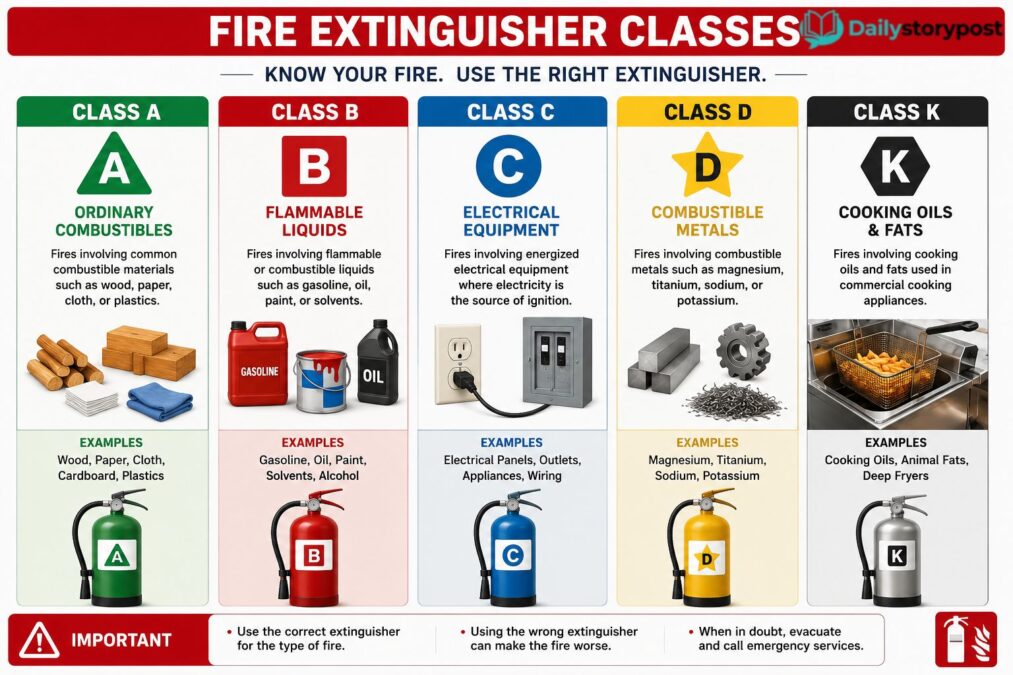
Many fire-related injuries occur because people attempt to fight a fire using the wrong equipment. While it may seem logical to use any extinguisher available, the wrong choice can create serious hazards.
For example, spraying water on a grease fire can cause burning oil to splash and spread flames rapidly. Similarly, using a water-based extinguisher on energized electrical equipment may increase the risk of electric shock.
Fire extinguisher classes exist to ensure that the right extinguishing agent is matched to the right fire hazard.
Knowing the correct class can help:
- Improve personal safety
- Minimize property damage
- Increase the chances of extinguishing a fire successfully
- Prevent dangerous reactions
- Support workplace safety compliance
A few moments spent understanding extinguisher classifications can make a significant difference during an emergency.
How Fire Extinguisher Classes Work
Every fire needs three basic elements to continue burning: heat, fuel, and oxygen. This combination is often referred to as the fire triangle.
Different extinguishers work by removing one or more of these elements. Some cool the fire, some smother it by removing oxygen, and others interrupt the chemical reaction that sustains combustion.
Because various fuels burn differently, fire safety experts classify fires according to the materials involved. Fire extinguishers are then designed and tested specifically for those fire categories.
This systematic approach allows users to quickly identify the correct extinguisher and respond more effectively during emergencies.
Class A Fires
Class A fires involve ordinary combustible materials that are commonly found in homes, schools, offices, and commercial buildings.
Examples include:
- Wood
- Paper
- Cardboard
- Cloth
- Furniture
- Plastics
These materials leave ash after burning, which is one reason they are classified as Class A combustibles.
Class A extinguishers typically use water, foam, or multipurpose dry chemicals. Their primary function is to cool the burning material and stop the combustion process.
Class A fires are the most common type of fire encountered in everyday environments.
For this reason, many residential and commercial buildings include extinguishers rated for Class A hazards.
Class B Fires
Class B fires involve flammable and combustible liquids.
Examples include:
- Gasoline
- Diesel fuel
- Oil
- Paint
- Solvents
- Alcohol-based products
Unlike Class A materials, these liquids do not burn in the same way. Water often cannot effectively extinguish these fires and may even spread burning liquid.
Class B extinguishers generally use foam, carbon dioxide, or dry chemical agents that smother the fire and separate the fuel from oxygen.
These extinguishers are commonly found in:
- Fuel storage facilities
- Automotive repair shops
- Manufacturing plants
- Warehouses
- Gas stations
Because flammable liquids are widely used across industries, understanding Class B fires is essential for workplace safety.
Class C Fires
Class C fires involve energized electrical equipment.
Examples include:
- Electrical panels
- Circuit breakers
- Wiring systems
- Computers
- Appliances
- Industrial machinery
One of the greatest dangers of electrical fires is the possibility of electric shock. For this reason, extinguishers designed for Class C fires use non-conductive agents.
Common extinguishing agents include:
- Carbon dioxide
- Dry chemical powder
These agents allow firefighters and occupants to suppress electrical fires without creating additional electrical hazards.
Once the electrical source has been disconnected, the fire may effectively become a Class A or Class B fire depending on the materials involved.
Safety should always be the first priority when dealing with electrical fires.
Class D Fires
Class D fires involve combustible metals.
Examples include:
- Magnesium
- Titanium
- Lithium metal
- Sodium
- Potassium
- Zirconium
Although these fires are relatively rare, they can be extremely dangerous. Many combustible metals react violently when exposed to water or traditional extinguishing agents.
Specialized dry powder extinguishers are required for Class D fires. These powders create a protective barrier that isolates the burning metal and controls the reaction.
Class D extinguishers are typically found in:
- Laboratories
- Aerospace facilities
- Metal processing plants
- Manufacturing operations
Because of their specialized nature, these extinguishers are generally used by trained personnel.
Class K Fires
Class K fires involve cooking oils, fats, and grease used in commercial food preparation.
Examples include:
- Deep fryers
- Vegetable oils
- Animal fats
- Commercial kitchen equipment
Modern kitchens often operate at very high cooking temperatures. As a result, traditional extinguishing methods are often ineffective.
Class K extinguishers use a wet chemical agent that reacts with hot cooking oils through a process called saponification. This process creates a foam-like layer over the burning oil, cooling the surface and preventing re-ignition.
These extinguishers are essential in:
- Restaurants
- Cafeterias
- Hotels
- Food processing facilities
Never use water on a grease fire. Doing so can cause an explosive steam reaction that spreads burning oil and significantly increases the danger.
Understanding Multi-Class Extinguishers
Many modern extinguishers are designed to handle more than one class of fire.
A common example is the ABC fire extinguisher.
These extinguishers are capable of addressing:
- Class A fires
- Class B fires
- Class C fires
Because they cover multiple hazards, ABC extinguishers are among the most popular choices for homes, offices, schools, and retail establishments.
Their versatility makes them practical for environments where several fire risks may exist simultaneously.
However, even multipurpose extinguishers have limitations. They are not intended for Class D metal fires or Class K cooking oil fires unless specifically rated for those hazards.
How to Identify Fire Extinguisher Classes
Modern fire extinguishers are designed to be easy to identify during emergencies.
Most units include clear labels showing:
- Fire class symbols
- Letter classifications
- Usage instructions
- Safety warnings
Many manufacturers also use pictograms to help users quickly recognize suitable fire types.
For example:
- A trash can and wood symbol often indicates Class A.
- A fuel can symbol commonly indicates Class B.
- An electrical plug symbol often represents Class C.
- A metal gear symbol may indicate Class D.
- A frying pan symbol generally represents Class K.
Taking time to review these labels before an emergency can improve response speed and confidence.
Understanding Fire Extinguisher Ratings
In addition to class labels, extinguishers often display ratings.
A rating such as 2A:10B:C provides information about firefighting effectiveness.
The number associated with Class A generally indicates the extinguisher’s relative firefighting capability for ordinary combustibles.
The number associated with Class B reflects the approximate square footage of flammable liquid fire the extinguisher can handle under controlled testing conditions.
The Class C designation indicates that the extinguishing agent is non-conductive and suitable for energized electrical equipment.
Higher ratings generally indicate greater firefighting capacity.
However, larger ratings often mean larger extinguishers, which may require additional training and physical strength to operate effectively.
Choosing the Right Fire Extinguisher
Selecting the correct extinguisher depends on the hazards present in a specific environment.
For homes, an ABC extinguisher is often considered the most practical option because it can address common household fire risks.
For offices, ABC extinguishers are also widely recommended due to the presence of paper products, furniture, and electrical equipment.
For garages and workshops, additional consideration may be needed if flammable liquids are stored or used regularly.
Commercial kitchens require Class K extinguishers because of the unique risks associated with cooking oils and grease.
Industrial facilities may require specialized extinguishers depending on the materials and processes involved.
The best extinguisher is the one that matches the hazards present in the area where it will be used.
Common Mistakes People Make
One of the most common mistakes is assuming that all extinguishers work on all fires.
This misconception can lead to dangerous outcomes during emergencies.
Other common mistakes include:
- Ignoring extinguisher labels
- Failing to inspect extinguishers regularly
- Using expired equipment
- Blocking access to extinguishers
- Neglecting employee training
- Attempting to fight fires that are already too large
Regular inspections and basic fire safety education can significantly reduce these risks.
Fire Extinguisher Safety Tips
Owning an extinguisher is only part of fire preparedness. Knowing how to use it safely is equally important.
Many fire safety professionals teach the PASS method:
Pull the safety pin.
Aim the nozzle at the base of the fire.
Squeeze the operating handle.
Sweep from side to side until the fire is extinguished.
Even with proper training, safety should remain the priority.
If a fire is spreading rapidly, producing heavy smoke, or blocking escape routes, evacuation should occur immediately and emergency services should be contacted.
No extinguisher is worth risking your life.
Conclusion
Understanding what is a fire extinguisher class is an essential part of fire safety. These classifications exist to ensure that fires are fought using the correct extinguishing methods, reducing the risk of injury and property damage.
Class A fires involve ordinary combustibles, while Class B covers flammable liquids. Class C addresses electrical equipment, Class D is intended for combustible metals, and Class K is specifically designed for cooking oils and grease.
By learning how fire extinguisher classes work, identifying labels correctly, and choosing the right extinguisher for your environment, you can respond more effectively during emergencies. Whether at home, in the workplace, or in a commercial setting, this knowledge helps create a safer environment for everyone.
A fire extinguisher is more than just a piece of safety equipment. When properly selected and understood, it becomes a valuable tool that can help prevent a small incident from becoming a major disaster.
Frequently Asked Questions
What is a fire extinguisher class?
A fire extinguisher class identifies the type of fire an extinguisher is designed to handle. Each class corresponds to a specific fire hazard, such as ordinary combustibles, flammable liquids, electrical equipment, metals, or cooking oils.
What are the main fire extinguisher classes?
The primary fire extinguisher classes are A, B, C, D, and K. Each class is designed for different fire types, helping users choose the safest and most effective extinguisher for an emergency.
Can one fire extinguisher be used on all fires?
No. Most extinguishers are designed for specific fire classes. While ABC extinguishers cover several common hazards, they are not suitable for every type of fire, such as combustible metal or commercial kitchen grease fires.
How do I know which fire extinguisher I need?
The right extinguisher depends on the fire risks in your environment. Homes and offices often use ABC extinguishers, while commercial kitchens require Class K extinguishers for cooking oil and grease fires.
What happens if I use the wrong fire extinguisher?
Using the wrong extinguisher can make a fire worse, spread flames, or create additional hazards. For example, applying water to a grease fire can cause burning oil to splash and intensify the fire.

Must read
Healthy Fitness Routines for Busy Working Professionals
The Case for Buying a Motorhome That Was Designed for Where You’re Going
Nature Funerals Are Growing and the Reasons Go Deeper Than Environmentalism
Branded Cupcakes for Corporate Events and Whether They Are Worth the Investment
BIO
| Label | Information |
|---|---|
| Article Topic | Skip Bin Waste |
| Main Focus | Waste Recycling |
| Key Question | Where Skip Bin Waste Goes |
| Waste Destination | Recycling Facility or Landfill |
| Recyclable Materials | Concrete, Bricks, Metal, Timber |
| Concrete Recovery | Recycled Aggregate |
| Metal Recovery | Metal Recycling |
| Timber Recovery | Mulch, Energy, Particleboard |
| Green Waste | Composting |
| Landfill Waste | Non-Recoverable Residuals |
| Provider Importance | Processing Capability |
| Licensing | EPA Licensing |
| Environmental Goal | Reduce Landfill Waste |
The moment a skip bin is collected from a driveway or building site, it tends to disappear from the hirer’s thinking entirely. The waste is gone, the project can move forward, and what happens to the contents of that bin between collection and final disposal is a question that most people don’t ask and wouldn’t know how to answer if they did.
The assumption, where people have one at all, is that skip bin waste goes to landfill. It’s a reasonable default given that landfill has historically been the primary destination for mixed waste, and it’s an assumption that leads people to treat the environmental dimension of skip bin hire as essentially fixed regardless of which provider they choose. Neither of these assumptions is accurate for skip bin waste processed at a modern licensed recycling facility, and understanding what actually happens changes both how the hire decision is made and how its environmental impact is assessed.
The Landfill Assumption and Why It’s Increasingly Inaccurate

The idea that skip bin waste goes straight to landfill made reasonable sense when waste processing infrastructure was less developed and the economics of materials recovery were less favourable than they are today. Mixed waste arriving at a facility with limited sorting capability and limited markets for recovered materials did largely end up in landfill, because the alternative was more expensive than the cost of disposal.
That picture has changed significantly as waste processing technology has improved, as landfill costs and regulatory requirements have increased, and as markets for recovered materials have developed to the point where the economics of sorting and recovery make sense for a much broader range of materials than they once did. A licensed recycling facility operating to current standards is not a landfill with a different name. It’s a processing operation that actively separates waste into material streams, directs each stream to the most appropriate end use, and sends only the genuinely non-recoverable fraction to landfill.
The proportion of a typical skip bin load that reaches landfill after processing at a well-run recycling facility is considerably smaller than the total waste volume, and for loads that are largely composed of construction materials like concrete, bricks, metal, and timber, the recoverable fraction can represent the majority of the total weight. Understanding this changes what it means to hire a skip bin from a provider with genuine recycling capability versus one whose processing is less rigorous.
How Waste Is Sorted and What Gets Recovered
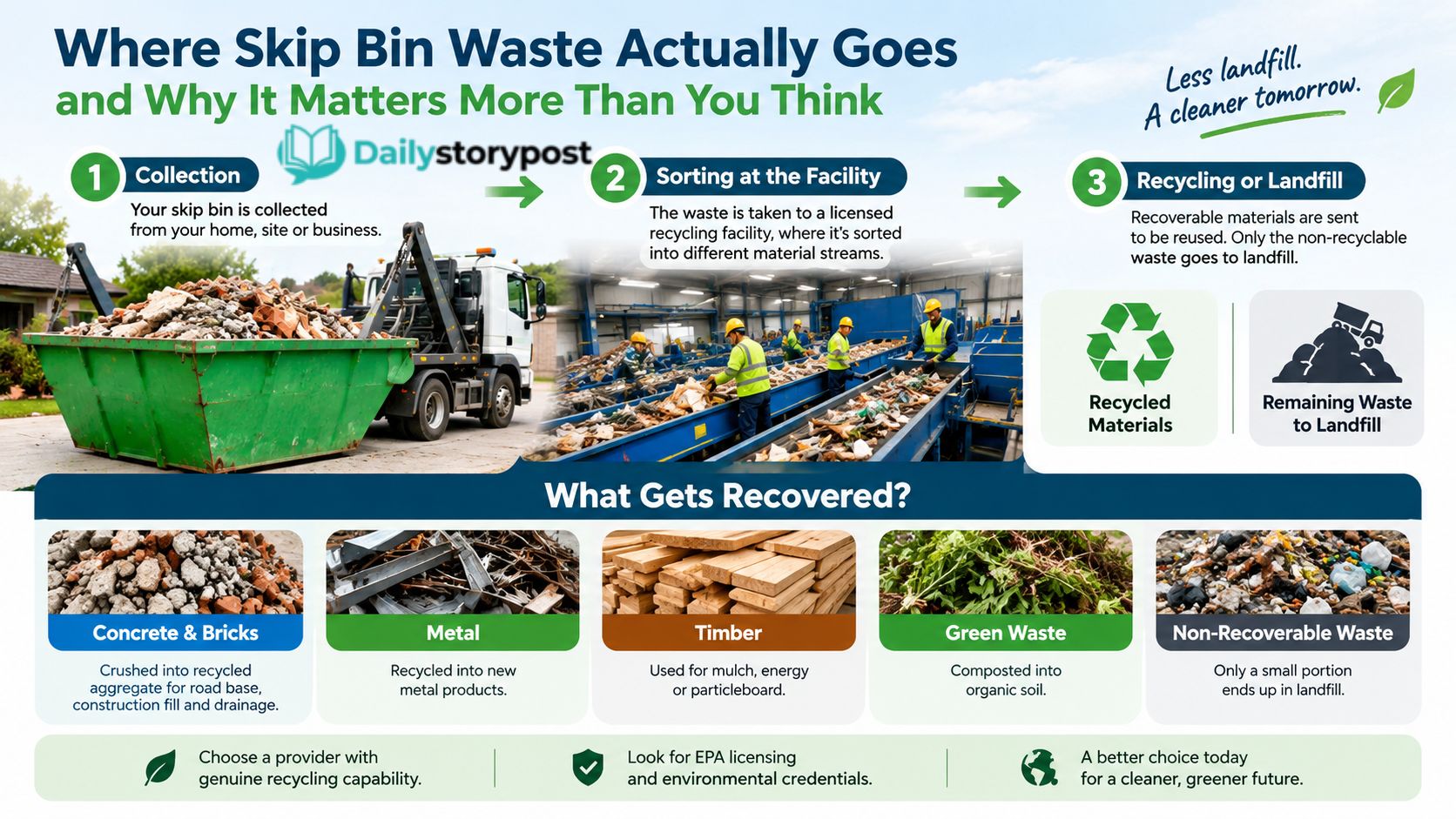
The sorting process at a modern waste recycling facility involves the separation of incoming mixed waste into distinct material streams, each of which has a defined end-use pathway that keeps it out of landfill and redirects it to productive use.
Concrete and masonry are among the highest-volume materials in construction and renovation waste and among the most straightforwardly recoverable. Crushed concrete and brick rubble is processed into recycled aggregate that is used as road base, construction fill, and drainage material. The market for recycled aggregate is established and substantial, which means the recovery rate for concrete and masonry from a well-run facility is high relative to other material types.
Metal is recovered across a wide range of forms, from structural steel and reinforcing bar through to the smaller metal components that appear in renovation waste. Metal recovery is one of the most economically straightforward recycling pathways because the market for recovered metal is global and the processing requirements are well-established. A skip bin load with significant metal content will see that metal separated and directed to metal recycling regardless of what else is in the load.
Timber is chipped and directed to mulch production, biomass energy, or particleboard manufacturing depending on the quality and contamination level of the recovered material. Green waste from garden and landscaping projects is composted and directed to agricultural and horticultural use. Both of these materials are recoverable from mixed loads at a facility with appropriate sorting capability.
For construction projects and homeowners in Sydney who want to ensure their waste is processed responsibly, a waste recycling facility in Sydney like Cobra Waste’s EPA-licensed operation in Yennora sorts every incoming skip bin load with the specific goal of diverting as much material as possible from landfill, with concrete, metal, timber, and green waste all directed to established recovery pathways rather than combined into a single disposal stream.
The fraction of a typical skip bin load that actually reaches landfill after this sorting process is the genuinely non-recoverable residual: contaminated materials that can’t be cleaned to a recyclable standard, mixed composites that can’t be economically separated into recoverable components, and materials for which no viable recovery pathway currently exists. This fraction is smaller than the total waste volume for most residential and construction loads, and it’s considerably smaller for loads that are dominated by the high-recovery materials described above.
Why the Provider’s Processing Capability Matters
The environmental outcome of a skip bin hire is not fixed by the nature of the waste. It’s significantly shaped by what the provider does with the waste after collection, which means two providers collecting the same load from the same site can produce very different environmental outcomes depending on their processing capability and commitment.
A provider that transports collected waste directly to a licensed recycling facility with genuine sorting capability is producing a different outcome from one that transports the same waste to a transfer station where it’s compacted and redirected to landfill with minimal sorting. Both providers collect the same skip bin and remove the waste from the site. The difference in what happens next is entirely a function of the provider’s processing infrastructure and approach.
The certification that distinguishes providers with genuine recycling commitment from those without it is worth checking before booking. EPA licensing confirms that the provider is operating within the regulatory framework for waste management. Green Star certification reflects an independent assessment of environmental performance that goes beyond the baseline compliance requirements. Neither certification is universally held by skip bin providers, and both are worth looking for when the environmental outcome of the hire matters to the person making the decision.
The direct tipping option that some licensed recycling facilities offer for builders and contractors who transport their own waste is the most direct form of access to the recycling infrastructure, allowing waste to be deposited at the facility for sorting and processing without the intermediary of a skip bin hire. For project managers with access to tipper trucks or skip trucks, this option combines the environmental benefits of facility-level sorting with the operational flexibility of direct delivery.
Why This Is Worth Understanding Before You Book
The practical implication of understanding what happens to skip bin waste after collection is that the choice of provider becomes more consequential than it appears when the assumption is that all waste goes to landfill regardless of who collects it.
A provider whose waste goes to a facility that sorts and recovers the recoverable fraction is producing a meaningfully better environmental outcome than one whose waste goes to a less rigorous destination, and for hirers who care about the environmental dimension of their project, that difference is worth factoring into the provider selection rather than treating all skip bin hire as environmentally equivalent.
The cost difference between providers with genuine recycling capability and those without it is not always significant, and in some cases the providers with stronger environmental credentials are competitively priced relative to those without them. The recycling economics that have made materials recovery more viable have also reduced the cost premium that was once associated with responsible waste processing, which means choosing the provider with better environmental outcomes is increasingly a decision that doesn’t require paying more for it.
The renovation or cleanout that generates a skip bin of mixed construction waste is a project with an environmental footprint that is partly determined by design decisions, partly by material choices, and partly by what happens to the waste at the end. The last of these is the dimension most people give the least thought to and the one that is most easily improved simply by choosing a provider whose processing capability makes recovery the default rather than landfill.
FAQs
1. Does skip bin waste always go to landfill?
No. At modern licensed recycling facilities, waste is sorted and recyclable materials are recovered before the remaining waste is sent to landfill.
2. What materials can be recovered from skip bins?
Common recoverable materials include concrete, bricks, metal, timber, and green waste.
3. What happens to concrete and bricks after collection?
They can be crushed and processed into recycled aggregate for uses such as road base, construction fill, and drainage.
4. Why does the skip bin provider matter?
Different providers may use different processing facilities. A provider connected to a licensed recycling facility can divert more recoverable materials from landfill.
5. How can I choose a more environmentally responsible skip bin provider?
Check whether the provider uses a licensed recycling facility and look for relevant environmental credentials, such as EPA licensing or Green Star certification.
Today 2:48 PM
discrepiton
Here are 3 SEO-friendly meta description options for your article, each kept concise and natural:
Meta Descriptions
Option 1 – Informative
Discover where skip bin waste actually goes, how recycling facilities sort materials, and why choosing the right provider can reduce landfill waste.
Option 2 – Curiosity-Driven
Ever wondered where skip bin waste goes after collection? Learn how concrete, metal, timber, and other materials are sorted and recycled.
Option 3 – Benefit-Focused
Learn what happens to skip bin waste after collection and how choosing a recycling-focused provider can support better waste recovery and less landfill.

A door is one of the first details people notice when they approach a home. It sets the tone for the entrance, influences how natural light moves through a space, and can even affect comfort and energy use. In 2026, door design is moving toward a balance of clean aesthetics, practical materials, better security, and thoughtful details.
The strongest designs are not necessarily the most elaborate. Instead, modern homeowners are increasingly choosing doors with simple shapes, natural finishes, useful technology, and materials that suit the local climate. Current design coverage also points toward minimalist forms, warm wood tones, larger areas of glass, earth-inspired colors, and greater customization.
Whether you are building a new house, renovating an older property, or simply replacing an entrance door, the following trends can help you find a style that looks contemporary without becoming dated too quickly.
BIO
| Label | Information |
|---|---|
| Thema | Door Design Trends 2026 |
| Türtyp | Moderne Haus- und Eingangstüren |
| Stil | Modern, schlicht und zeitgemäß |
| Beliebte Materialien | Holz, Glas, Metall und Verbundstoffe |
| Farbtrends | Schwarz, Anthrazit, Naturtöne und warme Farben |
| Design | Klare Linien und dezente Details |
| Beliebter Trend | Minimalistisches Door Design |
| Smart-Technik | Smart Locks und schlüsselloser Zugang |
| Nachhaltigkeit | Langlebige und energieeffiziente Materialien |
| Glasoptionen | Klar, mattiert, getönt oder strukturiert |
| Einsatzbereich | Eingang, Innenräume, Terrasse und Balkon |
| Auswahlkriterien | Stil, Sicherheit, Klima, Platz und Budget |
1. Minimalist Door Design
Minimalism continues to influence modern architecture, and doors are no exception. A minimalist door design usually relies on clean lines, flat surfaces, limited decoration, and carefully selected hardware.
Instead of carved patterns or complicated panel arrangements, modern doors may feature a smooth slab with one or two subtle grooves. The result is simple but intentional.
This style works particularly well with contemporary houses featuring large windows, concrete surfaces, stone walls, or neutral exterior colors. A simple door can also prevent a modern façade from looking visually crowded.
Matte finishes, slim handles, concealed hardware, and straight geometric lines are particularly suitable for this approach.
The important thing is not to confuse minimalism with a lack of character. A beautifully finished wood surface, unusual handle, or carefully positioned glass panel can give a simple door plenty of personality.
2. Modern Wooden Door Design

Wood remains one of the most versatile materials for residential doors. It brings warmth and texture to modern architecture, which can otherwise rely heavily on concrete, glass, metal, and smooth painted surfaces.
In 2026, natural-looking wood finishes are especially attractive because they soften the appearance of contemporary buildings. Warm oak, walnut-inspired shades, teak, and other wood tones can create a welcoming entrance without requiring decorative carving.
A modern wooden door can be completely flat, feature narrow vertical grooves, or combine wood with metal and glass. These combinations allow homeowners to retain the warmth of wood while achieving a distinctly contemporary appearance.
Material quality matters just as much as appearance. Exterior wood needs suitable protection from moisture, sunlight, temperature changes, and everyday wear. The right finish and maintenance schedule can significantly affect how well the door ages.
For homes in demanding climates, homeowners should also consider engineered or composite alternatives that provide a similar visual effect with different maintenance requirements.
3. Glass Door Design

Glass has become an important element in modern residential architecture because it can help connect indoor and outdoor spaces.
A glass-focused door design does not necessarily mean using a completely transparent door. Homeowners can choose frosted, textured, tinted, patterned, or partially glazed panels depending on the level of privacy required.
Large glass panels can make an entrance feel brighter and more open. They can work particularly well where a hallway or entrance area receives limited natural light.
However, appearance should not be the only consideration. Privacy, security, heat gain, glass performance, and orientation all deserve attention before choosing a glazed exterior door.
Energy performance also depends on the product and climate. ENERGY STAR notes that door performance requirements vary according to glazing level and climate zone, while factors such as U-factor and solar heat gain can help homeowners compare products.
For a modern home, a narrow vertical glass panel can often provide a good compromise between contemporary style, daylight, and privacy.
4. Bold Front Door Design
A front door does not always have to blend into the exterior. Sometimes the entrance looks better when the door becomes the focal point.
Bold colors, distinctive wood grain, unusual proportions, and strong hardware can transform an otherwise simple façade.
Deep green, charcoal, navy, muted terracotta, warm brown, and other nature-inspired shades can add character without making the house look overly dramatic. The best choice depends on the surrounding materials and architectural style.
A bold entrance works particularly well when the rest of the exterior is relatively restrained. If the walls, windows, roof, landscaping, and door all compete for attention, the result can feel busy.
Choose one strong visual feature and let it lead the design.
5. Smart Door Design
Technology is becoming increasingly integrated into residential entrances. Smart locks and keyless access can make a modern door more convenient while adding another layer of control.
Depending on the system, homeowners may use a PIN, fingerprint, smartphone, electronic key, or traditional key as a backup. Some systems can also provide access records or temporary codes for visitors.
The important point is that smart technology should complement the physical door rather than replace good security practices.
A strong frame, quality lock hardware, suitable hinges, secure installation, and durable materials remain essential.
When choosing a smart door design, also consider what happens during a power failure, whether the system has a reliable backup method, and how easily replacement batteries or components can be obtained.
6. Sustainable Door Materials
Sustainability is increasingly influencing decisions about home materials. For doors, that can mean choosing durable products, responsibly sourced wood, recycled materials, energy-efficient construction, or finishes designed for longer service life.
A sustainable choice is not simply a door made from a particular material. Durability and appropriate performance are equally important. A door that needs frequent replacement may have a larger environmental impact than a well-made product that remains useful for many years.
Energy performance is another important consideration for exterior doors. The U.S. Department of Energy notes that older, poorly insulated, poorly installed, or inadequately air-sealed exterior doors can contribute to air leakage and wasted energy.
This makes proper installation just as important as selecting an attractive design.
For buyers in markets where energy labels are available, certified performance information can make comparison easier. ENERGY STAR says its certified doors are independently tested and verified through NFRC-based ratings and must meet efficiency requirements appropriate to the relevant climate zone.
7. Black and Dark-Colored Doors
Dark doors continue to suit modern architecture because they create a strong contrast against lighter walls, stone, brick, concrete, or rendered façades.
Black, charcoal, deep brown, and dark bronze finishes can make an entrance look sophisticated without requiring complicated decoration.
A black door with simple hardware is particularly effective on minimalist houses. It can also work with warm wood, creating a balance between natural and industrial elements.
The surrounding colors should be considered before committing to a very dark finish. A door should feel connected to the rest of the exterior rather than appearing like an isolated feature.
Hardware can also change the final impression. Slim black hardware creates a discreet look, while brushed metal or warm metallic finishes can introduce contrast.
8. Sliding and Space-Saving Doors
Not every modern door needs to swing open in the traditional way. Sliding doors can be a practical choice where floor space is limited or where homeowners want a stronger connection between rooms and outdoor areas.
Sliding designs are particularly useful for patios, balconies, gardens, dining areas, and open-plan interiors.
Pocket doors are another option for interior spaces because the door panel can slide into a wall cavity when open. This can make small rooms easier to furnish.
However, the track system, wall construction, hardware quality, and maintenance requirements should be considered carefully.
For exterior sliding doors, weather sealing and glass performance are especially important. A beautiful door is not very useful if it allows excessive drafts, moisture, or heat transfer.
9. Double and Oversized Door Designs
Large entrance doors can create a strong architectural presence. Double doors are especially suitable for wide entryways and larger homes where the proportions of a standard single door may appear too small.
Modern double-door designs can use matching panels, large glass sections, natural wood, metal accents, or asymmetrical layouts.
Oversized doors also work well in homes with high ceilings because they maintain visual balance between the entrance and the overall building.
But bigger is not automatically better.
The door opening, structural support, hardware, clearance, and weight all need to be considered before installation. A large door must be properly engineered and installed so that it remains easy to operate over time.
10. Textured and Decorative Door Designs
Modern design does not mean every door must be completely plain. Subtle texture is an effective way to add depth without returning to overly elaborate traditional decoration.
Vertical grooves, fluted surfaces, geometric patterns, woodgrain textures, and narrow recessed panels can give a simple door a distinctive appearance.
One advantage of subtle texture is that it can create visual interest while keeping the overall form clean.
For example, a tall wooden door with evenly spaced vertical grooves can appear sophisticated without needing carved artwork or excessive ornamentation.
Texture should support the architecture rather than compete with it. If the exterior already contains strong stone patterns, decorative windows, or elaborate landscaping, a simpler door may be the better choice.
11. How to Choose the Right Door Design
Choosing a door should involve more than selecting a picture you like. The best door design is one that suits the building, climate, budget, security needs, and everyday lifestyle.
Consider the Home’s Style
Start by looking at the architecture of the house.
A flat-panel door may suit a contemporary home, while a warm wooden design may work better with a natural or transitional exterior. A traditional house may require more detailed paneling to maintain architectural consistency.
The door should feel like part of the building rather than an unrelated addition.
Think About the Climate
Climate can influence material selection, insulation, glazing, finishes, and maintenance.
A door exposed to intense sunlight may require a finish designed for UV exposure. Areas with high humidity may require materials and construction that resist moisture effectively.
For energy performance, homeowners should look at ratings appropriate to their climate rather than assuming one product will perform equally well everywhere. The Department of Energy specifically recommends considering climate when comparing U-factor and solar heat gain characteristics.
Balance Privacy and Natural Light
Glass can make an entrance brighter, but large transparent panels may not suit every property.
Consider how much visibility is actually desirable. Frosted or textured glass can provide daylight while reducing direct views into the home.
Prioritize Security
A beautiful entrance should also provide dependable security.
Consider the strength of the door slab, frame, hinges, locking system, glass specification, and installation quality. Smart locks can add convenience, but they should be part of a broader security approach.
Set a Realistic Budget
Door prices vary considerably depending on material, size, construction, hardware, glazing, customization, and installation.
Instead of spending the entire budget on the door itself, allow room for quality hardware, professional installation, finishing, and future maintenance.
A moderately priced door installed correctly can be a better long-term choice than an expensive door installed poorly.
12. Door Design Mistakes to Avoid
One of the most common mistakes is choosing a door based entirely on appearance.
A design may look excellent in a photograph but perform poorly in a particular climate or installation location.
Another mistake is ignoring measurements. Large doors require adequate clearance and suitable structural support, while sliding doors need enough wall or opening space.
Homeowners should also avoid selecting materials without considering maintenance. A finish that looks beautiful initially may require more care than expected.
Poor installation is another major issue. Even a well-designed, energy-efficient door can perform poorly if the frame is incorrectly fitted or gaps are not properly sealed.
ENERGY STAR emphasizes that selecting an appropriate product and installing it correctly both matter when seeking better performance.
Finally, avoid following trends too literally. A door is a long-term part of the home. It should reflect the building and the homeowner’s taste rather than simply copying whatever is currently popular.
Conclusion
The best door design trends for modern homes in 2026 are less about decoration and more about combining appearance with everyday performance.
Minimalist doors, natural wood, carefully selected glass, bold entrance colors, smart locks, sustainable materials, dark finishes, sliding systems, oversized entrances, and subtle textures all offer different ways to create a contemporary home.
The most successful choice will depend on the home’s architecture, local climate, security requirements, available space, and maintenance expectations.
Above all, choose a door that will still feel right several years from now. Trends can provide inspiration, but good proportions, durable materials, thoughtful detailing, proper installation, and practical performance are what make a door genuinely successful.
For exterior doors, energy performance should also be treated as part of the design decision. Official guidance from ENERGY STAR and the U.S. Department of Energy shows why climate, insulation, air sealing, and independently verified performance ratings deserve attention alongside appearance.
FAQs
What is the most popular door design trend in 2026?
Minimalist doors, natural wood finishes, large glass panels, and simple geometric details are among the popular choices for modern homes in 2026.
Which door design is best for a modern home?
A clean, simple door design with quality materials usually works well. Wood, glass, dark finishes, and subtle textures can all complement contemporary architecture.
Are wooden doors still a good choice in 2026?
Yes. Modern wooden doors remain popular because they add warmth and natural texture. With the right finish and maintenance, they can also be durable.
Are smart doors worth considering?
Smart locks can provide convenient keyless entry and features such as temporary access codes. They work best when combined with a strong door, frame, and reliable locking system.
How do I choose the right door design?
Consider your home’s architectural style, climate, security needs, available space, maintenance requirements, and budget before making a decision
https://dailystorypost.com/aimee-ffion-edwards/.
A beautiful garden does not usually come from buying the most expensive plants or filling every empty corner with decorations. The best outdoor spaces are planned around the conditions of the garden, the needs of the plants, and the way people actually use the space. This is where decoradyard garden tips by decoratoradvice can provide a practical starting point for creating a garden that feels attractive, comfortable, and manageable.
Good garden design combines appearance with everyday care. A planting scheme may look wonderful when it is first installed, but if plants are placed in unsuitable soil, watered incorrectly, or given too little room to grow, the garden can quickly become difficult to maintain. Reliable horticultural guidance consistently emphasizes understanding soil, moisture, planting conditions, and plant requirements before making major changes.
The most useful way to approach garden advice is therefore not to copy every idea exactly. Instead, consider each recommendation and adapt it to your own space. Whether you have a large backyard, a narrow side garden, a small patio, or a collection of containers, thoughtful planning can make a noticeable difference.
BIO
| Label | Information |
|---|---|
| Topic | Decoradyard Garden Tips |
| Source | DecoratorAdvice |
| Main Focus | Garden planning and care |
| Garden Type | Home and outdoor gardens |
| Key Purpose | Create attractive, practical spaces |
| Plant Selection | Choose plants for local conditions |
| Soil Care | Improve soil with organic matter |
| Watering | Water according to plant needs |
| Mulching | Helps retain moisture and control weeds |
| Garden Design | Balance plants and decorations |
| Maintenance | Regular pruning, weeding, and care |
| Budget | Suitable for simple or larger projects |
Understand Your Garden First
Before planting anything, spend some time observing the space. This simple step can prevent many common gardening mistakes.
Look at how sunlight moves across the garden during the day. Some areas may receive several hours of direct sunlight, while others remain shaded by walls, fences, trees, or nearby buildings. This information matters because plants have different light requirements.
Also pay attention to areas where water collects after rain. Persistent puddles can indicate drainage problems, while very dry areas may lose moisture quickly. The type of soil matters as well. Clay soils tend to hold water and nutrients, while sandy soils generally drain faster and can lose moisture more quickly. Loam sits between these extremes and is often considered versatile for gardening.
A short period of observation can tell you more than making immediate changes. Walk around the garden at different times of day and notice which areas are sunny, shaded, wet, dry, exposed, or sheltered.
Plan Before You Plant
A garden plan does not need to be complicated. Even a rough sketch can help you decide where plants, pathways, seating, containers, and decorative features should go.
Start by identifying the areas that have a clear purpose. You might want one section for flowers, another for herbs or vegetables, and a comfortable area for sitting. In a family garden, you may also need open space for children or pets.
Think about the mature size of plants rather than their size when purchased. A small shrub can eventually become much larger than expected. Giving plants enough room reduces overcrowding and makes future maintenance easier.
A good layout also considers movement. Paths should be practical rather than decorative alone. If you regularly need to reach a shed, compost area, outdoor tap, or planting bed, make sure the route remains convenient.
The goal is to create a garden that looks natural while still working well for everyday life.
Choose Plants Carefully
One of the most important principles behind successful gardening is choosing plants that match the conditions available.
Instead of selecting a plant simply because it looks attractive, consider its sunlight requirements, soil preferences, mature size, water needs, and seasonal behavior. Plants suited to the conditions generally require less intervention and have a better chance of remaining healthy.
For gardens with challenging moisture conditions, plant selection becomes particularly important. Some spaces may be wet during winter and dry during summer, creating difficult conditions for plants that prefer consistent moisture. In such cases, choosing tolerant varieties and improving the planting area can be more effective than repeatedly replacing plants that struggle.
It is also useful to combine plants with different forms. Taller plants can provide structure, medium-sized plants can fill the middle layer, and low-growing plants can soften borders. Repeating a few plant types can create a more cohesive appearance than using dozens of unrelated varieties.
Build Healthy Soil

Healthy soil is one of the foundations of a successful garden. Plants depend on soil for water, nutrients, air, and physical support, so improving soil can often produce better results than simply adding more fertilizer.
Organic matter such as well-rotted garden compost can improve soil structure and help support healthy plant growth. It can also contribute to moisture retention and nutrient availability.
If the soil is heavy and compacted, adding suitable organic matter can improve its structure over time. Sandy soils can also benefit from organic matter because it can help them retain moisture and nutrients more effectively.
Avoid assuming that every soil problem can be solved with the same product. First identify the problem, then choose an appropriate improvement.
A useful approach is to improve soil gradually rather than trying to transform the entire garden in one weekend. Working section by section makes the project easier and allows you to see how plants respond.
Use Compost Wisely
Compost is one of the simplest ways to improve a garden naturally. Homemade garden compost can return useful organic material to the soil while making productive use of suitable garden and kitchen waste.
Well-made compost can improve soil structure, aeration, and biological activity. The Royal Horticultural Society also notes that compost can be used as a soil improver and as a mulch.
A compost pile generally benefits from a mixture of green materials, which are richer in nitrogen, and brown materials, which provide more carbon. Suitable brown materials can include dry plant material and shredded cardboard, while green materials can include grass clippings and soft plant waste.
Compost should be properly decomposed before being used around plants. Fresh or poorly decomposed material may not provide the same benefits and can create problems.
For gardeners following decoradyard garden tips by decoratoradvice, compost is particularly useful because it supports both practical gardening and attractive garden maintenance.
Water More Thoughtfully
Watering seems simple, but it is easy to get wrong.
A common mistake is following a rigid watering schedule regardless of weather or plant requirements. Plants need different amounts of water depending on their species, age, soil, container size, and current weather conditions.
Established plants in garden beds may need much less water than newly planted specimens. Containers, meanwhile, can dry out more quickly because they have a limited volume of growing medium.
When watering established plants during dry periods, slow and thorough watering is generally more useful than giving plants a small amount every day. The RHS recommends watering deeply enough to moisten the soil around the root zone and allowing the surface to dry before watering again, while taking the individual conditions into account.
Water early when practical, particularly during hot conditions. Avoid wasting water on paths and decorative surfaces when the goal is to hydrate plants.
Make Mulch Part of the Plan
Mulch is one of the most useful garden materials for combining appearance and practical maintenance.
A layer of suitable mulch can help conserve moisture, suppress weeds, protect soil, and contribute organic matter when biodegradable materials are used. It can also give planting beds a cleaner and more finished appearance.
Organic materials such as garden compost, leaf mould, and suitable bark products can be used as mulch. Decorative materials such as gravel and stone can also serve as surface coverings, although they do not improve soil in the same way organic materials do.
When using organic mulch, apply it over the soil surface rather than piling it directly against plant stems or trunks. Keeping the material appropriately spaced from stems helps avoid creating unnecessarily damp conditions around the plant base.
Mulching is particularly useful in gardens where watering and weeding take up considerable time. It does not eliminate maintenance, but it can make routine care easier.
Improve Garden Decoration
Garden decoration should support the planting rather than overwhelm it.
A simple seating area, attractive container, pathway, raised bed, trellis, or carefully positioned focal point can give a garden personality without making it feel crowded.
Think about balance. If one side of the garden contains a large decorative feature, the opposite side may need visual weight through planting or another structural element. Repeating materials or colors can also help different parts of the garden feel connected.
Containers are especially useful for renters, small gardens, patios, and areas where changing the layout frequently is desirable. They allow you to introduce flowers, herbs, shrubs, or small trees without committing to permanent planting.
The strongest decorative choices are often the ones that serve more than one purpose. A trellis can provide visual interest while supporting climbing plants. A raised bed can improve accessibility while creating a strong garden feature. A pathway can guide visitors while protecting planted areas from being walked on.
Create Layers
A garden can feel flat when everything is planted at the same height. Layering creates depth and makes a small space feel more interesting.
Use taller plants toward the back of a border or against suitable structures. Medium-height plants can occupy the central area, while groundcovers and low plants can fill the front.
This approach also helps frame important areas. A taller plant can draw attention toward a seating space, doorway, or focal feature without requiring an artificial decoration.
However, avoid planting too densely. Plants need room for mature growth and airflow. What looks slightly sparse during the first season may become full and balanced later.
Patience is an important part of garden design.
Think About Seasonal Change
A garden should not be planned only for the moment when it looks best.
Consider what will happen throughout the year. Some plants provide spring flowers, others offer summer color, while shrubs, grasses, berries, bark, or evergreen foliage can contribute interest during colder months.
Seasonal planning also spreads maintenance across the year. Instead of having everything flower at once and then lose interest, choose plants with different periods of activity.
This approach can make the garden feel alive throughout the seasons and reduce the temptation to make large changes whenever one group of plants finishes flowering.
Maintain Without Overworking
A beautiful garden does not need to be perfectly tidy every day.
Regular maintenance should focus on the tasks that genuinely improve plant health and garden function. Remove invasive weeds before they become established, prune plants when appropriate, keep paths accessible, and remove damaged or diseased material when necessary.
Do not automatically cut back every plant as soon as it looks untidy. Some seed heads and stems can provide winter interest or habitat for wildlife. The right maintenance approach depends on the plant and the purpose of the garden.
It is also useful to group plants with similar maintenance needs. This makes watering, pruning, and seasonal care easier because similar tasks can be completed in the same area.
Avoid Common Mistakes
One of the most frequent gardening mistakes is buying plants before understanding the garden. A beautiful plant will still struggle if its light, soil, moisture, or temperature requirements do not match the location.
Overwatering is another common issue. More water is not automatically better. Poorly drained soil can create conditions that damage roots, while unnecessary watering wastes resources.
Overcrowding can also create problems. Plants that are placed too close together may compete for resources and become difficult to maintain as they mature.
Another mistake is relying too heavily on fertilizer. Healthy soil and appropriate planting are often more important than adding nutrients repeatedly. The RHS notes that many established ornamental plants do not require regular feeding, while containers, seedlings, and edible crops may have different needs.
Finally, avoid changing everything at once. A garden is a living system, and gradual improvements make it easier to identify what works.
Adapt Tips to Your Budget
Garden improvement does not have to be expensive.
Start with low-cost changes that have a practical effect. Improving soil with homemade compost, adding mulch, dividing suitable plants, cleaning existing features, and reorganizing containers can make a noticeable difference without requiring a major investment.
If you have a larger budget, you can consider structural improvements such as new paving, raised beds, irrigation systems, fencing, lighting, or built-in seating.
Prioritize projects according to how much they improve the garden. A well-planned planting bed may provide more long-term value than several decorative objects that have little practical purpose.
A useful rule is to spend first on the garden’s foundations: soil, drainage, suitable plants, and access. Decorative additions can come afterward.
Use Seasonal Planning
Garden care becomes easier when tasks are divided throughout the year.
In spring, concentrate on preparing planting areas, removing unwanted growth, adding suitable organic matter, and planning new plants.
Summer is often focused on watering during dry periods, monitoring containers, removing weeds, and keeping plants supported where necessary.
Autumn can be a good time for clearing selected areas, collecting leaves for compost, planting suitable trees and shrubs, and preparing the garden for colder weather.
Winter provides an opportunity to assess the garden structure and plan changes for the coming growing season.
The exact timing depends on your local climate, plant varieties, and weather conditions. A seasonal checklist should therefore be treated as a guide rather than a rigid schedule.
Make the Garden More Sustainable
A well-designed garden can be attractive while using resources responsibly.
Composting reduces the amount of suitable organic waste that leaves the garden and creates a useful soil amendment. Mulching can reduce moisture loss and suppress weeds. Choosing plants suited to local growing conditions can also reduce the need for intensive watering and intervention.
Avoid automatically replacing plants that struggle. First investigate why they are failing. The problem may be unsuitable soil, insufficient light, poor drainage, or excessive moisture.
In gardens with fluctuating wet and dry conditions, selecting resilient plants and improving soil structure can reduce long-term maintenance. The RHS recommends combining appropriate plant selection with measures such as organic matter, mulching, and improved drainage where necessary.
Sustainability does not mean making the garden look untidy. It means making thoughtful choices that allow the garden to function efficiently.
Make Small Changes First
One of the best ways to use decoradyard garden tips by decoratoradvice is to begin with one manageable area.
Choose a border, patio corner, entrance, or container collection. Assess the conditions, remove obvious problems, improve the soil where appropriate, choose plants carefully, and then add a small number of decorative features.
Once that area begins to work, you can use what you have learned elsewhere.
This approach is more practical than attempting a complete garden transformation immediately. It also allows you to discover your personal gardening style. Some people prefer structured borders, while others enjoy informal planting, containers, edible gardens, wildlife-friendly spaces, or minimalist designs.
The best garden is not necessarily the one that follows every trend. It is the one that suits its location and the people who use it.
Final Thoughts
Decoradyard garden tips by decoratoradvice can be used as a starting point for thinking about garden design, planting, decoration, and maintenance. The most effective approach is to combine attractive ideas with sound horticultural principles.
Start by understanding your space. Check sunlight, soil, moisture, drainage, and available room. Choose plants according to their real growing requirements rather than appearance alone. Improve soil with suitable organic matter, use mulch where helpful, and water according to conditions instead of following an inflexible routine.
From there, introduce decorative elements that make the garden more enjoyable without making maintenance unnecessarily difficult.
A successful garden develops over time. Plants grow, seasons change, and your priorities may change as well. By making thoughtful improvements and observing how the garden responds, you can create an outdoor space that is healthy, attractive, practical, and easier to care for.
The most important lesson is simple: good garden design starts with understanding the space before trying to change it. Once that foundation is in place, even small improvements can make a meaningful difference.
Frequently Asked Questions
1. What are Decoradyard Garden Tips by DecoratorAdvice?
Decoradyard Garden Tips by DecoratorAdvice are practical ideas for improving garden layout, planting, decoration, watering, and maintenance. They can be adapted to different garden sizes and conditions.
2. How should I start using these garden tips?
Begin by checking your garden’s sunlight, soil, drainage, and available space. Choosing plants that suit these conditions is usually more effective than trying to change the garden to suit unsuitable plants.
3. How often should I water my garden?
There is no single watering schedule that works for every garden. Water according to the weather, soil, plant type, and stage of growth. For many established plants, less frequent but thorough watering is preferable to shallow routine watering.
4. Is mulch useful for garden maintenance?
Yes. Mulch can help retain soil moisture, suppress weeds, improve soil, and reduce maintenance. Organic mulch should generally be applied as a substantial surface layer while keeping it away from plant stems and trunks.
5. Can I improve my garden without spending a lot?
Absolutely. Start with simple improvements such as better plant placement, compost, mulch, regular weeding, and reorganizing existing containers or garden features. Small changes can improve both the appearance and practicality of an outdoor space.


 Celebrity4 months ago
How Tall Is Glen Powell? Height, Facts, and More
- Celebrity4 months ago
Fielder Jewett Age: Everything We Know About Him in 2026
- Technology4 months ago
How Simpcitt Is Changing the Way People Think Today
- Celebrity4 months ago
Who Is Meredith Schwarz? Key Facts You Should Know
- Home Safety3 months ago
How KDArchitects Landscape Ideas by Morph Transform Outdoor Spaces
- Food & Drink4 months ago
Where to Find the Best Piononos de Santa Fe Near Me Today
- Business4 months ago
How to Buy Milohacherry Coin Safely and Get Started Today
- Business4 months ago
How Driving Modes in Cadillac Lyriq Impact Range and Efficiency